Thursday, July 26, 2007

My Data Smog: Email Stats

I just read this Slate article on the 1997 book 'Data Smog' and was amused by the following passage from its author, David Shenk:
Ten years and about 50,000 inbox e-mails later, it's pretty obvious to me that smart filters have a vital role to play.

Hah. I just checked my email inbox. It goes back to February 7, 2007 -- 168 days. It contains no spam, and almost no newsletter type email -- I delete all that stuff. I have 14,145 items in there, an average of 84 per day.

Startup life.

Thursday, July 05, 2007

iFolded

I caved in and bought an iPhone. I am not, I repeat not, an early adopter. I bought my last cell phone in 2004, and that was the first time I'd ever had a phone that could do anything besides make calls.

At the time, I was working on a big project about the future of mobile for NTT, and I thought, "time to give this stuff a try". So I bought the Nokia 6600 'Pandaphone' from T-Mobile with the unlimited data plan. Bluetooth, color screen, cameraphone, web browser, email... yeah baby.

I actually got the bluetooth modem trick to work, a few times. Slow as molasses. I never, ever figured out how to email a photo from the cameraphone, despite hours and hours spent online and on the phone with their tech support. As for web browsing? Give me a break.

So it turned into a phone for... making phone calls. And I stayed stuck in the 90s.

Then came the iPhone.

You know the drill. You know the hype. Well, my friend Jason Zien bought one, standing in line on the weekend to get it. On Sunday, he came up to Redwood City to show it off.
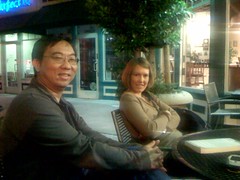
Jason and Andrea

Jason's iPhone was a revelation. The touch screen, as everyone says, is magical. No other word for it. The screen resolution and sharpness is amazing. It's gorgeous and clear. It... just... works. I instantly fell in love - not because it's an object of desire, but simply because it is... useful.

I took a picture of him and Andrea. And emailed it to myself. It showed up.

Hey, T-Mobile and Nokia! Are you listening?

So I decided to buy one. This, you recall, after the "They didn't sell out, nothing to see here, move along" weekend.

Well, actually, in Northern California, they did sell out. On Monday at lunchtime, none to be had at the Burlingame store -- and none had arrived that day. Monday night, I checked the 'locator' on apple.com. Sigh. None were going to arrive on Tuesday. Now, I am not the kind who has to have things Right Now -- but what i hate is the incremental process of getting something. If I could have just ordered one to show up in two weeks, that would have been fine, but this Chinese water torture approach was not going to work. So I checked the locator for Columbus Ohio, where lo and behold, there were plenty of iPhones. I got my friend Craig to buy me one at 9am the next morning. Which he did (thanks Craig!!) with no muss, no fuss, no line.

His critical addendum to the iPhone,you can see in the photo yourself -- click for detail.
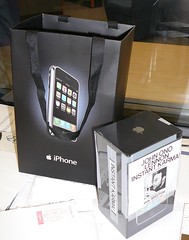
iFolded

I love it. It's still not entirely set up, and I love it. I've only found one problem, which I will note here in detail.


Apple, you are morons for how you handle wifi passwords.
Maybe this is in a manual somewhere -- but the device is so damn easy to use, I haven't cracked the manual, and I don't want to. If you have a hex or ASCII WEP password to your wifi hub (doesn't everyone?), you have to go into Settings and change the settings (under wifi, other, security) to "WEP hex or ASCII". Then, when you enter said password, if it's hex, you have to precede the hex with a $ sign like this: $4B42C7 and if it's ASCII you need to put it in quotes like this: "password". Otherwise it Will Not Work. Aargh. Jason bailed me out on this -- thanks Jason !! -- I'm not sure if it was due to his PhD in computer science or his slavish fanboy devotion to Apple :-) -- it *couldn't* have been that he RTFM, nah -- but he saved me in the one pinch I've had thus far.

Tomorrow, life will go on more or less as before.

Today, well, cool.

Thursday, June 28, 2007

PowerSet: Let's Re-Invent Everything

I drove up to San Francisco for the inaugural PowerLabs open house. Nearly four hours later when it was all over, I gave three PowerSet people who had missed their train a ride down the Peninsula. "What's great about this company is the business people," said one, a PhD. "They really seem to know what they're doing."

Yeah. There are a lot of smart tech guys who've been in too many dumb companies. This certainly isn't one of those.

Cover Slide

The big knocks on PowerSet -- 'PowerHype,' etc. -- can be broken out into three categories:

1) Can they build it?
2) Will anyone care / do they have a business?
3) What will Google do in response?

I've not been worried about 1) for quite a while. While there are many real technical challenges to bringing up a web-scale search service, there are many real technical guys at PowerSet who've done it before and can do it again. Since modern search is far more heterogeneous than most people realize -- a spaghetti ball of models, features, and evidence driving every instance of ranking and retrieval -- PowerSet doesn't have to climb all the way to the top of some brand-new semantic mountain to launch *something* decent. What they're trying to do is technically hard and thus quite risky, but they've certainly got the right team to try.

Scott presents demo search results

To my surprise, they made a very impressive stab at persuading me about 2) 'Will anyone care' tonight. Though they compared it to World of Warcraft several times, the PowerLabs concept bears the most resemblance to an open source project in general, and the Slashdot community as a particular instantiation. Submissions, votes, feedback, and all the other communal goodies of the open source way, wrapped in a slick interface and presented to prosumers who will give feedback and product advice, tell their friends, blog incessantly, and create a large nucleus of interest and buzz about their new service when it emerges. It's smart. It's also, take 2, very risky. It can fail in a lot of peculiar ways, and it's a brand-new innovation to the company launch problem. We'll see if they celebrate or curse this decision years from now.

I am compelled to add that it's not just the concept that's impressive about the business side of this company. Their PR has been impeccable since launch, their fund-raising was also eyebrow-raising, and this whole evening was handled very well. Steve Newcomb, COO and founder, was calm and impressive in presenting the vision, answering nearly every question, and conveying an absolute sense that this company stands for something, and is striving to do something great. I dare say it's almost impossible to fake that sort of sincerity; I admire them greatly for making this huge bet, and am intrigued to watch whether they can pull it off.

Steve discussing a query

3) remains to be determined. WWGD is a (the?) key Valley question, ignored by any technology company at their peril. The big G is not infallible, but no one has even stressed them yet. Microsoft managed at least two really outstanding strategic pivots (Office in response to Borland, and Explorer in response to Netscape) and web search is Google's game. Tonight, Steve and I had a spirited exchange about whether Google can emulate the results of natural language using statistical methods. While I concede his point that there are edge and corner cases that can't be done by any other method, I maintain that enough core cases can be derived from query behavior analysis to really limit PowerSet's perceived advantage to end-users, and thus their motivation to switch. Steve's ultimate response was, "in any case, we'll have moved search technology forward"; a good answer for the world, regardless of what that might mean for PowerSet's option-holders.

I got laugh line of the night, so I've gotta blog that. Steve revealed some numbers about their indexing time per sentence; he played the crowd well, with repeated, "I don't know if I should tell you... Barney [CEO Barney Pell] might kill me..." before the big reveal. When a minute or two later he said again, "Barney might kill me," I called out, "Who killed Steve?" in best PowerSet query style. Laughs all around.

Summary: This is still incredibly early. The core of their technology just came out of a LAB, for God's sake; they won't have a real search engine for half a year at least, if not longer; and any speculation about whether they'll be better than some multi-billion dollar competitor is kind of like wondering whether Greg Oden will break any of Wilt Chamberlain's records.

They've put together an impressive bet; they're making all the right noises; they could become General Magic, or they could become great. In any case, it'll be fun to watch.

Startup life.

Update: Dan Farber at CNET and Kevin Burton also have commentary.

Sunday, June 24, 2007

Close your eyes and make cyberwar go away

The New York Times today published an incredibly bad piece on cyberwar. Entitled 'When Computers Attack,' its entire purpose seems to be to allow reporter John Schwartz to wave his hands, make vague assertions, and explain how there's nothing to see here.

I am a big fan of the writing of military expert John Robb, so perhaps I am particularly sensitive to the fragility of complex technical systems and the real risk of their disruption. But even with that discount factored in, the Pollyanna attitude of the piece is incredible. Here's an early paragraph:
"But how bad would a cyberwar really be — especially when compared with the blood-and-guts genuine article? And is there really a chance it would happen at all?"
I'm just guessing here, but it appears that the two main claims of the piece will be, "It won't happen," and "If it does, it won't be bad." Hmmm. Kind of reminds me of our government response to a certain famous memo.

Yes, Virginia, terrorism happens, and yes, it can be bad.

The meat of the article supports the possibility of cyberwar being a big deal:
* "China, security experts believe, has long probed United States networks."
* "The United States is arming up, as well. Robert Elder, commander of the Air Force Cyberspace Command, told reporters"
* "An all-out cyberconflict could “could have huge impacts,” said Danny McPherson, an expert with Arbor Networks."
Sounds pretty serious, right? But that's before Schwartz dismisses the experts.
"Whatever form cyberwar might take, most experts have concluded that what happened in Estonia earlier this month was not an example."
Wait a minute! Estonia is a particularly wired place, and pissed-off persons unknown brought key infrastructure of the country to its knees by blocking access -- to banks, to government websites, to overseas consulting gigs. How is this not cyberwar? A blockade is an act of war. This was a blockade. Just because the harbors and ports are digital doesn't make it any less harmful, or any less aggressive.

Schwartz then makes assertions that net out to, "it wasn't cyberwar because the Russian government wasn't involved, just sympathetic Russian hackers." Come on. When the United States was funding the Contras in Nicaragua, using convenient irregulars to mask our role, was it any less warlike of us?

Then we get to the most breathtaking dismissal of all, especially for a writer in New York:
...the technologies and techniques used in the attacks were hardly new, nor were they the kind of thing that only a powerful government would have in its digital armamentarium.
Perhaps Schwartz's clever uses of obscure synonyms for 'arsenal' dazzled him so much that he forgot a certain incident carried out by a non-powerful-government with non-new-technology that had some slight consequences for world history:


I'm afraid it may be worse than bad memory -- other parts of Schwartz's brain also appear to be functioning poorly. Next, he argues that since war bears risks, no one will enter into it:
In fact, an attack would have borne real risks for Russia, or any aggressor nation, said Ross Stapleton-Gray, a security consultant in Berkeley, Calif. “The downside consequence of getting caught doing something more could well be a military escalation,” he said. That’s too great a risk for a government to want to engage in what amounts to high-tech harassment, Mr. Lewis said. “The Russians are not dumb,” he said.
Yeah, right. Those attacks that result in escalation never happen.

So Schwartz doesn't understand war. But he can still go out with a bang: he doesn't understand economics, either!
...Kevin Poulsen, a writer on security issues at Wired News, said that he had difficulty envisioning the threat that others see from an overseas attack by electrons and photons alone. “They unleash their deadly viruses and then they land on the beaches and sweep across our country without resistance because we’re rebooting our P.C.’s?” he asked...
...Down on earth, by comparison, this correspondent found himself near the Kennedy Space Center in a convenience store without cash and with the credit card network unavailable. “The satellite’s down,” the clerk said. “It’s the rain.” And so the purchase of jerky and soda had to wait. At the center’s visitor complex, a sales clerk dealt with the same problem by pulling out paper sales slips.

People, after all, are not computers. When something goes wrong, we do not crash. Instead, we find another way: we improvise; we fix. We pull out the slips.
This is breathtakingly bad fluff.

Does Schwartz not understand why we bombed the crap out of Germany and firebombed Japan during WWII? It wasn't because the Germans couldn't "pull out the slips" and build airplanes underground. It wasn't because the Japanese couldn't "pull out the slips" and rebuild their small workshop factories. It's because total war is economic war, and a good way to win an economic war is destroying the efficiency of your competitor.

No silly "Red Dawn" style invasion is necessary. Economic blackmail -- or economic destruction -- is plenty good enough.

Our entire society rests on fragile, difficult-to-defend infrastructure. At a basic level, our survival depends on systems of distribution for food, water, and energy which might easily be disrupted. At a more elevated level, our prosperity and happiness as a nation depends on those systems, and others -- such as international trade, the media, the financial markets -- not just working, but working flawlessly and efficiently. Any attack which reduces that efficiency has real economic consequences to us, whether we "pull out the slips" or not.

Cyberwar can impact those systems, and thus it is a real threat, a real risk, and something that deserves being taken seriously. Bin Laden understood this. It's a shame that John Schwartz doesn't.

Who are the heroes? And why do we ignore them?

There were endless news stories about the tragic death of nine South Carolina firefighters in the media last week. Driving to and from work the day of their funeral, I caught at least three distinct references on NPR, including a brief clip of the mayor speaking in somber tones about what heroes they were. The coverage was hagiographic, everywhere -- as in this piece, Firefighters pay tribute to those who answered 'death's call' -- in a small-town paper in Massachusetts. Or this piece, 'Brotherhood of Honor,' from Worcester, Massachusetts.

Massachusetts!! It's a long way from South Carolina.

Firefighting is a hard, dangerous job. I believe that those who choose to become firefighters do so partially out of a sense of duty and service, and I am sure that they are brave. Their death was tragic, and their remembrance worthwhile.

But their incredibly public death and remembrance starkly demonstrated what is utterly, totally missing from our public discourse today -- and the echo of its absence rang loud to me all that day, and still.

The day after the South Carolina fire, nine soldiers and Marines died in Iraq.

Where were their two thousand news stories?

Every day, our soldiers and Marines are dying in Iraq. Eighty-six have died thus far in June -- four every day, day after day. Their job is harder and more dangerous than any firefighter's. They too serve out of a sense of duty and service, and their bravery is beyond question.

But their death is doubly tragic, and their lack of remembrance doubly stark. They are dying not in an attempt to extinguish a blazing warehouse. They are giving their lives in a futile attempt to temporarily bank the raging fires of sectarian collapse in Iraq, so that the failed policies and cynical policy-makers of the Bush administration can escape part of the blame they so richly deserve.

Meanwhile, we, and our media, sit silent, our gaze awkwardly averted; or we throw ourselves into frenzied ceremonies around some other, smaller, but at least meaningful tragedy. How can we let one small sadness overwhelm our sense of the greatest tragedy of our times? Why does no one make this point? Silence, here, is complicity.

Thursday, June 07, 2007

Event search drives traffic; Zvents expands partnerships

The incredibly exciting opportunity that drove me to start Zvents is that one third of local search -- "discover things to do" -- is an untapped market. I define local search as three major areas:

* What to buy: Yellow pages & merchant search
* What to do: Events, movies, restaurants, activities
* What happened: News

Zvents:  Events are the untapped 1/3 of local search

Of these three, "what to do" is completely untapped, whereas the other two have seen significant efforts, both by traditional media and by Internet companies.

There's a simple reason that "What to do" is untapped - it's hard to do well. Events expire rapidly, events are highly structured (think repeating series of plays, with different times on weekends) and events are very fragmented -- in a major metro area, there are tens of thousands of events in a given week, across a vast range of categories like sports, music, performing arts, classes, politics, community, clubs... the list is endless.

So it's very gratifying to see the positive response that our local search engine for things to do has garnered -- both among users, where we've seen huge growth in traffic; and partners, where we've been signing up media firms at a steady clip, with the New York Times Regional Media Group being our latest relationship.

Local analysts Pete Krasilovsky and Greg Sterling both wrote about our latest news this morning, and I encourage you to check out their pieces. "Discover things to do" is a great opportunity and a fun place to be, and across the market of Zvents and the others chasing it, I look forward to huge advances and lots of fun.

Startup life!

Wednesday, June 06, 2007

Props to Google: Users *Create* Content!

I was looking up the upstate New York church where my cousin Greg is getting married Saturday, and lo and behold, there's a new feature on Google Maps:
User-Created content -- not user-generated!

There in the lower left, it says, "New! User-Created Content"

I can hardly express how this warms my heart. The big G realizes that users are people, and that they are creative! Too bad that most of the Web 2.0 community is so far behind. If I could choose one phrase to have a stake driven through its soulless, MBA-mouthed, PowerPoint-printed heart, it would be "User Generated Content". I have blogged in the past about using human words for human deeds (see note at the end of the post). Machines generate. Humans create. Nice one, Google.

Google Street View: Brin's Transparent Society

I just read all the comments over at BoingBoing about Google's Street view.

All these people need to buy and read David Brin's excellent essay, "The Transparent Society".

Welcome back to the village, humanity.

Startup CEO: Three kinds of serious conversations

There are three kinds of serious conversations that the leader of a startup can have with his team. The first kind is, "We're in deep trouble here, and we have to fix it."

Six weeks ago, I had one of those conversations with our engineering team at Zvents. As our traffic and partner network really started to grow, we were having scaling issues, uptime issues, and process issues, and after a few wobbles, there was a real possibility that we were going to fall over hard. The team responded magnificently. We've completely reworked our release and QA processes, and we've fixed some glaring issues in the code base, and I no longer stay awake at night worrying about what will break next.

The second type of serious conversation is, "We've got an incredible opportunity here, and we have to focus the particle beam and make it happen."

I had that conversation with the engineering team yesterday, and we'll be talking about it with the whole company in the next few days. In a startup environment, it's just as important to succeed at upside tasks as it is to respond to downside risks -- and we've got some really great prizes in clear view that we need to achieve. The reason that we're all in a startup is the joy of running absolutely flat out to grab those prizes, and we're going to have a fun -- but deadly serious -- couple of months of sprinting to take Zvents to the next level.

The third type of serious conversation is, "We just accomplished something important and amazing. Now, what do we do next?"

We've had that talk a few times at Zvents already. As a startup, you don't last two years without a few amazing victories along the way. The first time was when we successfully launched at Web 2.0 on about $50K in total funding, and there have been several others since. I look forward to having that conversation again -- both soon, and many times more.

Startup life.

Monday, June 04, 2007

Kawasaki's Web 2.0: But Weren't Websites Always Cheap?!

Guy Kawasaki is very smug about how cheap it was to launch a moderately useless site like Truemors.

As I recall Bubble 1.0, one of the big problems was that people confused the following:
* ideas vs. businesses
* web sites vs. software

Nothing has really changed. In 1999, it was cheap and easy to turn an idea into a web site. In 2007, (shock!) it's still easy to turn an idea into a web site -- though now with open source and open APIs, you can get a more functional one for your trouble.

It's always been hard and expensive to write software, and it's always been hard and expensive to create a real business. Even in 2007, it's still hard and expensive to build a real software-driven business. There are always exceptions; but their rarity proves the rule.

If this is link-bait to make Guy $150 per month, and to garner a few hundred thousand page views from users who will never come back, then fine. It costs me nothing, and it benefits Guy hardly at all.

Meanwhile, the real business of building Internet-focused, software-based businesses goes on. And at Zvents, it's going really well.

Wednesday, May 30, 2007

Why is Facebook hiding platform application user numbers?

Facebook's launch of their new platform has been the hot story of Silicon Valley for nearly a week now. An initial rollout of 80 apps on an open platform created a wave of buzz and adoption that has been impressive to behold. But the hot story hasn't been just about Facebook. It's been about Jeff Jarvis' teenage son Jake creating a last.fm app that garnered over 15,000 users. And most notably, it's been about iLike's astonishing rise to over 750K users in less than a week.

Are stories like this one on VentureBeat -- all about iLike, and not about Facebook -- the reason that, with the rollout of their new "most recent" and "most popular" functionality for finding apps:

facebook apps detail

Facebook appears to have hidden the number of users for a particular app? I can still see the friends, I can still see the reviews, but I can no longer see the number of users:

fbapps

Whassup? Hey, Facebook! Doesn't open mean open?

Thursday, May 24, 2007

Zvents answers Eric Schmidt's question; John Battelle worried

On Searchblog, John Battelle writes,

"The Day I Ask a Search Engine 'What Shall I Do Tomorrow'...is the day one of you, please, should put me out of my misery... once I can have that kind of a conversation with a search engine, it's entirely arguable if the search engine is anything other than a human being, right?

John, Zvents has been built to answer exactly this question. Here's your answer to, "What shall I do tomorrow in San Rafael?".

And since Eric Schmidt asked the question in the first place, here's the answer to "What shall I do tomorrow in Mountain View?"

It's not human. But it's pretty smart!

Tuesday, May 22, 2007

Hey, Scoble: It was a B-24, not a B-17

Robert writes: "Oh, heck, I just posted some photos of a B-17 that’s been buzzing Silicon Valley, too."

That was a B-24, not a B-17. Twin tails. Four engines. Passed over my house about six times this weekend, at about a thousand feet.

At one point I thought I saw a B-25 as well (twin engines, twin tails) but I may have been mistaken.

I had a thoroughly mis-spent youth as a WWII airplane geek, and occasionally it pops through. How mis-spent, you might ask? How many nine-year-olds do you know that listened to their record player on an original B-26 pilot's flight helmet instead of earphones?

Saturday, May 19, 2007

Steve Ballmer: Market Capitalism Doesn't Work

I found this quote on Donna Bogatin's Digital Markets blog. Regarding Google:
“I don’t really know that anyone has proven that a random collection of people doing their own thing actually creates value,” [said] Steve Ballmer, Microsoft CEO.

Um... free markets? Invisible hand? Hello, Steve.

I don't want to beat on Mr. Ballmer too hard, because it's always been a peculiar tension of capitalism and a thorn for its most fervent (market fundamentalist) adherents that the macrofauna and apex predators of capitalism, public companies, work nothing like free markets internally, and in fact strongly resemble the command-and-control economies that capitalism is supposed to supersede.

Nonetheless, a very funny quote.

Thursday, May 17, 2007

No wonder the country is a mess

The NY Times notes some interesting results of financial disclosure forms by presidential candidates:

Representative Duncan Hunter, Republican of California, reported assets worth hundreds of thousands of dollars but also said he owed more than $30,000 in car loans and more than $75,000 in credit card debt.

There are two ways to read this:

a) for a decade Congress has been run by people like Duncan Hunter who are too dumb to understand that $75K in credit card debt is a financial disaster, and equally too dumb to understand that pile-driving the budget into the ground by combining an expensive war, a moronic new Medicare benefit, and giant tax cuts is a financial disaster.

b) is even more depressing. For a decade Congress has been run by people who don't care about running debts up while in office, because they know their special-interest buddies will lavish them with rewards for their toadying once they've done their duty and graduate to the private sector.

The Times being the Times, of course they focused the article on the fact that some of the candidates are rich.

Wednesday, May 16, 2007

Hand Wringing About Education

It seems to be our national pastime to worry that today's kids are kind of dumb compared to some ideal representation of past glory. One of the key ways this is expressed is bloviating articles about dumb high school kids that come out every time some national test result is published.

The New York Times is the latest perpetrator of this meme. Despite generally positive results versus earlier years, the entire spin of their article is dumb kids, dumb kids, dumb kids. But the remarkable point to me is what an incredibly high standard they need to invent in order to garner a suitable quotient of worry.

They write:
...more than half of the nation’s high school seniors still showed poor command of even basic facts like the impact of the cotton gin on the slave economy or the causes of the Korean War...

I am in the tiny fraction of humans who enjoyed and excelled at history so much as to enter a PhD program at a top tier university in the subject, and I don't view either of those items as "basic facts". A "basic fact" is something like, "What was the outcome of the Korean war for Korea?" (answer: Partition along the demilitarized zone between North and South).

"Causes of the Korean War" is really quite complicated, especially when subjected to the incredibly imprecise testing method of multiple choice, with questions designed to trick. It's only because I was a very serious war history geek that I knew much about the occupation of Korea by Japan from 1905 through World War II when I was in high school, and any attempt to address the causes of the Korean War which ignores the post-colonial impact of Japan's departure is laughable.

I also happened to study the history of science and technology in grad school, and I find the claim that "impact of the cotton gin on slavery" is a "basic fact" to be downright silly. I suppose that the answer to the question is that the cotton gin made the refinement of cotton into cloth cheaper and faster, driving down its overall price and putting demand-driven market pressure on the South to vastly expand the institution of slavery in order to grow more cotton to process with cotton gins; but I would be extremely impressed with any high school kid who could come up with that; so impressed as to probably offer them a summer internship at my startup.

The reporter, Sam Dillon, closes his piece with an example multiple choice question, which is a rhetorical hook designed to let your typical upper-middle-class, highly-educated New York Times reader walk away from the article shaking their head about those dumb kids:
The test asked students, “What did Abraham Lincoln mean in this speech?” and listed four possible answers.

a) The South should be allowed to separate from the United States.
b) The government should support slavery in the South.
c) Sometime in the future slavery would disappear from the United States.
d) Americans would not be willing to fight a war over slavery.

Fifty four percent of the fourth graders given the test failed to pick the correct answer, letter c). “These are very worrisome results,” Mr. Rabb said.

You've got to be kidding me. That is the trickiest wording imaginable for that question; the right answer is wishy-washy and vague, and the three wrong answers are precise sentences about the key issues of the civil war, with the key word "not" either missing or present to make them false. Knowledgeable is not logical, and logical is not diligent and precise, and I am dubious that this question answers anything more than whether high school seniors are highly logical, diligent, and precise in their test-taking. No. Shock, surprise.

Parents have been griping about the fallen morals and depressed intellect of their children since at least the introduction of that social scandal, the waltz, into England in 1820. Get over it, everyone. Your kids are going to be fine.

Monday, April 23, 2007

The Best and the Brightest

David Halberstam died yesterday. I am currently reading his outstanding book, 'The Best and the Brightest' which is a extraordinary series of portraits of the men who made up the Kennedy administration, and who led us in to Vietnam. I discovered from the New York Times that he lived in the Bay Area and died in an auto accident in Menlo Park.

He wrote of people who were so close to greatness, but created tragedy. I'm fascinated at how this small tragedy has revealed to me how close to this great author I was, and never even realized it.

His book has one core message, which applies to startups as much as politics: Don't waste your opportunity to make a difference by being arrogant, narrow-minded, or dogmatic about reality. Adjust and thrive. Deny and die. Even the best and the brightest can blow it.

Wednesday, April 18, 2007

Negotiating for Minority Rights with Car Bombs

It's a horrific scene, and an even more horrific number of deaths. No, not in Virginia -- in Baghdad. Again. 115 die in a single gigantic explosion.

This is really quite simple, and it's based on the diffusion of technology, in the form of high explosives. The Sunnis are a minority in Iraq, and to make their position even worse, they're the deposed former nasty overlords and oppressors of the Shiites. The Shiites are, not surprisingly, highly enthusiastic about massacring the Sunnis as soon as the Americans get out of the way.


But wait, say the Sunnis. You may massacre us -- there's frankly not much we can do to prevent it, since you've got lots of guns and explosives of your own, plus control of government and an advantage of numbers -- but we're certainly not going to go quietly, and you're not going to get anything like peace. In fact, you'll get fear and chaos and random death which will make any massacre-based future social order carry the distinct and unpleasant taste of spoiled victory. We'll mostly be dead, but we'll keep blowing you up, too.

So let's negotiate about this whole massacre thing, OK?

That's why 115 people just died in a single gigantic explosion in Baghdad today. To send a simple message -- "Let's talk."

Iraq is very far gone, and it's almost entirely due to widespread availability of guns and high explosives, which make conversations like this quite a bit more percussive and destructive than they otherwise would be. So what do the gun nuts recommend for our society? More of that recipe, please!

Saturday, April 14, 2007

Product Review: Moka Junior Express Coffee Maker

I've now raved about this little coffee maker to a couple of people, so I'm writing a review that I can point everyone to instead of repeating myself. This is a stove-top coffee maker that looks (and works) a lot like those little camping espresso makers you saw back in college:

moka

It takes about a cup of water and about two scoops of coffee. The water steams up through the grounds as you heat it on the stove, and the results are dark, rich, and utterly fabulous. It's coffee that is halfway to espresso - I cut it about 50/50 with milk -- and the taste is out of this world. For $20 at Target or Amazon, it's a real winner.

The back story on this is interesting: My friends Matt and Jen swear by this coffee maker, and have been using it (and its larger sibling) for years. They bought me one about three years ago, and somehow I never got around to using it -- force of habit with the drip coffee maker, I guess. We have a friend, Ophelia, who travels lightly through life -- she's biked across the U.S., and is currently camping out in the Bay Area post grad school at M.I.T. When she recently showed up to stay with us, carting her approximately 40 pounds of worldly possessions, lo and behold, a Moka had made the cut. After she made me some coffee from it (which Matt and Jen did years ago -- mea culpa, guys, I was young and foolish!) I was hooked. I dusted their old gift off and have been avidly using it ever since. I now plot how to get a first cup of Moka coffee in me before I head to the office -- a real behavioral change. For the cost of three drinks at Starbucks, you've gotta try it.

Sunday, April 01, 2007

Concierge selling services: Reverse your model!

There are a ton of people in the business of packaging up your stuff to sell on eBay. AuctionDrop are the ones that come first to my mind, but this article lists about a dozen.

The basic premise is that a local business can provide a service involving listing, packaging, shipping, and managing the paper trail for used goods and make plenty of money. All these people have focused on sellers thus far -- I suppose on the theory that the motivation to clean our your garage is stronger than the motivation to buy some shiny object in a faraway place.

This is silly, because attraction to shiny objects is deeply human. In my previous post, I discussed a multi-city search for a Performax sander. I'm a woodworker, and I've decided it's time that I had a sander in the shop because I'm tired of two-week gaps in projects while I take a pile of panels to the mill. In my quick survey of Craigslist, I found broadly similar sanders that I would buy in cities ranging from Boston to Los Angeles -- at prices ranging from $850 to $2800. Now, guess which one I want to buy? But do I even want to deal with the hassle of trying to arrange buying something remotely and shipping it to myself? Unlikely. I may even have a tough time having a serious conversation with the seller, given that what I want to do bears a strong resemblance to some well-established scams.

AuctionDrop and others should step in to this market.
"Listing, packaging, shipping, and managing the paper trail for used goods" can work with the causality arrow pointed in both directions -- or, said another way, as a post-purchase rather than pre-purchase option. I want to be able to get an approximate quote from AuctionDrop to drive to zip code 90210, pick up a purchase weighing 300 pounds, put it in a box, and send it to me in 94025. I want to be able to loop them in to the email chain after I buy something in Boston and have them deal with the details. Inspection of the goods at a basic level would be great, too -- there would have to be some significant liability waivers, but "I plugged it in and it ran" is certainly something that they could indemnify. This could be very lucrative. In order to get the $850 sander vs. the $1800 sander, it's easily worth it to me to pay someone $500, and I can't imagine that shipping costs from LA are more than about $200. There's a fat margin in there waiting to be exploited by... someone.