This superb article on GigaOm really puts into context what Facebook is doing. Google's search evolution was two stages:
1) Realize that the links that people create on the Web are a vote about the value and subject matter of websites ("hubs and authorities", aka PageRank)
2) Realize that the clicks that people execute on Google search pages are a vote about the value and subject matter of websites (machine learning on clicks)
and then organize search results according to the composite of the value indicated by those votes.
Facebook is now re-executing stage 2) and moving to stage 3):
2) Capture clicks via toolbar integration on websites and do Google-comparable analysis
3) Realize that "like" and other social actions (forward etc.) that people execute on the Web are a vote about the value and subject matter of websites
and then organize recommendations and exposure (in the Feed, etc.) according to the composite *personalized* value indicated by those votes.
Facebook is truly turning itself inside out with this move, and may re-shape the web around itself, in the same way that desire for "Google Juice" has re-shaped the web as we know it today. The beta phase of social networking has ended, and the real product now emerges. This is going to be an interesting ride.
Wednesday, April 21, 2010

Tuesday, March 16, 2010
Geeks of the world, please help Dilbert!
I just spent five minutes at the Dilbert cartoon site being frustrated by my utter inability to find a comic strip from a few years ago that I'd like to hang on my wall. It's the sequence where the new product is a box of twigs and nuts, which is integrated with the customer's network by running a CAT-5 cable through the box.
There's no text search function on Dilbert.com. No way that I can type in the relevant keywords and find the panels. Google and Bing are mute to the right answer. This is a tragedy. Given that approximately 100% of Dilbert's target audience is search-savvy, 10% of Dilbert's audience could configure a nice SOLR implementation between dinner and breakfast, and at least 1% of Dilbert's target audience could implement a crawler/scraper/parser combo to pull ASCII text out of the GIF panel archive, this is highly sub-optimal.
Geeks of the world, please help Dilbert!
There's no text search function on Dilbert.com. No way that I can type in the relevant keywords and find the panels. Google and Bing are mute to the right answer. This is a tragedy. Given that approximately 100% of Dilbert's target audience is search-savvy, 10% of Dilbert's audience could configure a nice SOLR implementation between dinner and breakfast, and at least 1% of Dilbert's target audience could implement a crawler/scraper/parser combo to pull ASCII text out of the GIF panel archive, this is highly sub-optimal.
Geeks of the world, please help Dilbert!
Monday, August 31, 2009
Running a business and blogging is usually a zero-sum game
While there are definitely exceptions to the rule -- exceptions whom I would love to emulate -- in general it seems to be true that most serious executives at Silicon Valley startups have very little time for blogging. My personal experience is that it's also quite difficult to blog about the most interesting topics raised by startup life. Either the item is somehow closely tied to some proprietary insight or information, or the item will complicate a relationship with a major partner. Since we have *many* major partners at Zvents throughout the local Internet space, I am particularly sensitive to the latter.
I literally have at least a dozen topics of both business neutrality and general interest stuck on my bulletin board to get onto Onotech in the next few months. Perhaps I'll have time, or perhaps it will be a few months yet before I find an occasion to write again. In any case, rest assured that things are going very well at Zvents in the meantime.
I literally have at least a dozen topics of both business neutrality and general interest stuck on my bulletin board to get onto Onotech in the next few months. Perhaps I'll have time, or perhaps it will be a few months yet before I find an occasion to write again. In any case, rest assured that things are going very well at Zvents in the meantime.
Sunday, April 12, 2009
Obama grandstanding while Rome burns
You might have heard from the President that an historic opportunity exists today to refinance your mortgage. Rates are low, the sun is shining, and the green shoots of recovery are just around the corner.
In extensive prepared remarks, the most powerful man on earth took a break from puppy-choosing to inform the American people of the following:
So in the midst of the biggest financial crisis of the past eighty years, the President of the United States just expended a precious media outreach opportunity to talk about a program with a maximum impact of about 3/2000ths of the annual American economy of $13 trillion. I hate to be so cavalier with billions, but that's not even a drop in the bucket.
This is insane.
Meanwhile public and steath bailouts such as a $300 billion loan guarantee to Citibank go undiscussed by the President. The increasingly dubious and never-ending AIG bailout has still not been adequately explained to the public by any public official, much less the President.
Talk about seriously misplaced priorities.
I know that Obama has only been in office about eighty days. I know that he's dealing with dozens, if not hundreds, of critical activities. But by any rational measure, the financial crisis is #1 on his list -- and probably #2,3,4,5 and 6 as well. It's that important.
So far he's blowing it. Come on, Mr. Obama. I voted for you because I expected better than this. If I wanted a crony-supporting, opaque, denial-ridden bailout of giant financial companies at the expense of the taxpayer and the common man, I could have voted for a Republican.
The American people deserve better than being patronized on the one hand and pillaged on the other. May we please have more change and less hope?
In extensive prepared remarks, the most powerful man on earth took a break from puppy-choosing to inform the American people of the following:
"So the main message that we want to send today is, there are 7 to 9 million people across the country who right now could be taking advantage of lower mortgage rates. That is money in their pocket. And we estimate that the average family can get anywhere from $1,600 to $2,000 a year in savings by taking advantage of these various mortgage programs that have been put in place."Let's take the high side of President Obama's numbers. 9 million people * $2000 equals 18 billion dollars in annual savings.
So in the midst of the biggest financial crisis of the past eighty years, the President of the United States just expended a precious media outreach opportunity to talk about a program with a maximum impact of about 3/2000ths of the annual American economy of $13 trillion. I hate to be so cavalier with billions, but that's not even a drop in the bucket.
This is insane.
Meanwhile public and steath bailouts such as a $300 billion loan guarantee to Citibank go undiscussed by the President. The increasingly dubious and never-ending AIG bailout has still not been adequately explained to the public by any public official, much less the President.
Talk about seriously misplaced priorities.
I know that Obama has only been in office about eighty days. I know that he's dealing with dozens, if not hundreds, of critical activities. But by any rational measure, the financial crisis is #1 on his list -- and probably #2,3,4,5 and 6 as well. It's that important.
So far he's blowing it. Come on, Mr. Obama. I voted for you because I expected better than this. If I wanted a crony-supporting, opaque, denial-ridden bailout of giant financial companies at the expense of the taxpayer and the common man, I could have voted for a Republican.
The American people deserve better than being patronized on the one hand and pillaged on the other. May we please have more change and less hope?
Sunday, March 22, 2009
Facebook vs. Internet: Advantage, Facebook
Jesse Stay's excellent post on the search potential of Facebook's Lexicon has inspired me to put down a few quick thoughts on Facebook's nearly unlimited potential to capture the future of what John Battelle calls the "database of intentions".
Google's extraordinary accomplishment is that they used superb statistical analysis to make some vague sense out of the complete mishmash that makes up the flat-text Web. But while that accomplishment is considerable, at the end of the day, they're still dealing with mush.
Facebook's great opportunity is that everything within Facebook is structured; and increasingly, users express their intentions against this structured data at scale in a way that can be very productively mined -- for product improvement, for user retention, for advertising. For insight.
Riddle yourself this: You have 200 Facebook friends. They are all pretty active. Does your FB feed actually show every single event from every single one of them? No, it doesn't. FB is algorithmically determining what is most interesting to you - dynamically - based on how much attention you pay to what those users do, and how you interact with them. Facebook knows how much you care about each of your friends. It knows whether you pay more attention to people near or far, to men or to women, to people you work with, went to high school with, or went to college with. It knows because you explicitly describe all those relationships, in a way that Google can never grasp no matter how world-beating its science and how vast its server farms.
Or consider the Lexicon graphs that Jesse highlights in his post. Google Trends can handily generate one of those for you from their painstakingly de-mishmashed dataset. But they can't tell you the demographic breakdown of that interest, because they don't know who's male and who's female. Nor do they know whether that interest is coming from people directly associated with the topic in question; for instance Ohio State, my alma mater.
Here's the Ohio State Lexicon graph, which I have annotated to show the precision of Facebook's read on the importance of a topic:

Here's the term 'Football' as a proxy from the new Lexicon, which doesn't yet allow analysis of arbitrary search terms.

As you can see, FB could allow you to slice and dice the 'Ohio State' search by any number of associations -- male vs. female, by age, and whether the person had attended Ohio State. Google can't do that. No one else can do that, because no one else has assembled a gigantic graph of defined and structured entities within which users apply their attention and annotation.
The implications for local search alone boggle my mind - that's food for another post.
It's worth noting that Lexicon is really, really slow right now. My hat is off to FB for making it work at all -- I assume that some implementation of Cassandra is behind the current Lexicon, and one reason they may not be allowing open-text searching in the new Lexicon is because while they're pushing the envelope developing it, they're crunching big batch jobs on a limited set of terms in Hadoop for the more sophisticated analysis presented there. Zvents has developed some pretty sophisticated internal analytics based on Hypertable, and I'm familiar with the challenges that this sort of slice-and-dice presentation presents -- they are considerable.
Google has taken the statistical analysis of flat text about as far as it can go. The question is, what next? Powerset attempted one approach, which was the semantic analysis of that same flat text. We'll see whether Microsoft and Powerset can make a go of that - the jury is definitely out whether it adds value in a computationally and commercially tractable manner. But in the meantime, my bet is on Facebook -- because the information potential of a structured system is vastly greater than that of a flat corpus, and it is far more tractable to parsing.
Internet, watch out. Here comes Facebook.
Google's extraordinary accomplishment is that they used superb statistical analysis to make some vague sense out of the complete mishmash that makes up the flat-text Web. But while that accomplishment is considerable, at the end of the day, they're still dealing with mush.
Facebook's great opportunity is that everything within Facebook is structured; and increasingly, users express their intentions against this structured data at scale in a way that can be very productively mined -- for product improvement, for user retention, for advertising. For insight.
Riddle yourself this: You have 200 Facebook friends. They are all pretty active. Does your FB feed actually show every single event from every single one of them? No, it doesn't. FB is algorithmically determining what is most interesting to you - dynamically - based on how much attention you pay to what those users do, and how you interact with them. Facebook knows how much you care about each of your friends. It knows whether you pay more attention to people near or far, to men or to women, to people you work with, went to high school with, or went to college with. It knows because you explicitly describe all those relationships, in a way that Google can never grasp no matter how world-beating its science and how vast its server farms.
Or consider the Lexicon graphs that Jesse highlights in his post. Google Trends can handily generate one of those for you from their painstakingly de-mishmashed dataset. But they can't tell you the demographic breakdown of that interest, because they don't know who's male and who's female. Nor do they know whether that interest is coming from people directly associated with the topic in question; for instance Ohio State, my alma mater.
Here's the Ohio State Lexicon graph, which I have annotated to show the precision of Facebook's read on the importance of a topic:
Here's the term 'Football' as a proxy from the new Lexicon, which doesn't yet allow analysis of arbitrary search terms.
As you can see, FB could allow you to slice and dice the 'Ohio State' search by any number of associations -- male vs. female, by age, and whether the person had attended Ohio State. Google can't do that. No one else can do that, because no one else has assembled a gigantic graph of defined and structured entities within which users apply their attention and annotation.
The implications for local search alone boggle my mind - that's food for another post.
It's worth noting that Lexicon is really, really slow right now. My hat is off to FB for making it work at all -- I assume that some implementation of Cassandra is behind the current Lexicon, and one reason they may not be allowing open-text searching in the new Lexicon is because while they're pushing the envelope developing it, they're crunching big batch jobs on a limited set of terms in Hadoop for the more sophisticated analysis presented there. Zvents has developed some pretty sophisticated internal analytics based on Hypertable, and I'm familiar with the challenges that this sort of slice-and-dice presentation presents -- they are considerable.
Google has taken the statistical analysis of flat text about as far as it can go. The question is, what next? Powerset attempted one approach, which was the semantic analysis of that same flat text. We'll see whether Microsoft and Powerset can make a go of that - the jury is definitely out whether it adds value in a computationally and commercially tractable manner. But in the meantime, my bet is on Facebook -- because the information potential of a structured system is vastly greater than that of a flat corpus, and it is far more tractable to parsing.
Internet, watch out. Here comes Facebook.
Monday, March 16, 2009
Reality Check of the Day: China v. USA
One of my great realizations from living in the UK for a couple years is just how utterly the U.S. media lacks any perspective on American military actions abroad. The 'abroad' is completely redundant, of course - unlike every other country on earth, aside from our distant independence and single civil war, the U.S. military has NEVER had military action that wasn't abroad.
This piece in Newsweek caught my eye:
For the reality-based coalition, here's a handy world map showing the location of the United States, China, and the 2001 and 2009 incidents between the U.S. and Chinese military:
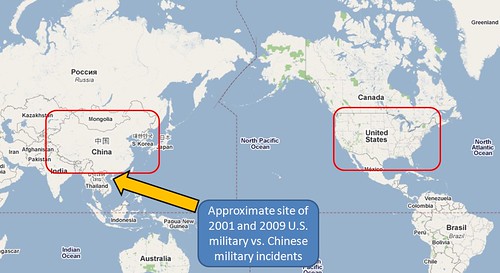
Who, exactly, is being "militarily more aggressive"?
This piece in Newsweek caught my eye:
"The confrontation last week between a U.S. ship and five Chinese naval craft was just the latest of many low-grade military clashes in the South China Sea, the site of numerous territorial disputes. It was eerily similar to the "Hainan Island" incident in 2001..."But the punch line was the ending quote:
"This confrontation had been preceded by increasingly bold behavior on the part of People's Liberation Army ships and planes. "They seem to be militarily more aggressive," said Obama's new National Intelligence director, Dennis Blair..."Um. Yeah.
For the reality-based coalition, here's a handy world map showing the location of the United States, China, and the 2001 and 2009 incidents between the U.S. and Chinese military:
Who, exactly, is being "militarily more aggressive"?
Monday, March 02, 2009
Greenspan 2004: Your house will cover your personal debt
I randomly found my grumpy notes on this whistling-past-the-graveyard gem from Sage Alan in February 2004, and thought it was well worth posting:
Boy, he sure got that one right, didn't he?
The finances of American households are in generally good shape even though consumers have increased their debt and bankruptcy filings have surged, the Federal Reserve chairman, Alan Greenspan, said yesterday.
In a speech to the Credit Union National Association in Washington, Mr. Greenspan said that an extended period of low interest rates and extra cash from mortgage refinancing had given borrowers flexibility to better manage their debts...
Consumer debt reached a record $2 trillion in December, according to the most recent figures from the Federal Reserve. That includes credit cards and car loans, but not mortgages...
[Greenspan] said that American households own more than $14 trillion in real estate assets and that mortgage refinancing and the rise in home values have helped to bolster consumer spending in economic hard times as well as better periods.
"Over the past two years, " he said, "significant increases in the value of real estate assets have, for some households, mitigated stock market losses and supported consumption."
Boy, he sure got that one right, didn't he?
Wednesday, February 11, 2009
Geography is Destiny: Religion
This fascinating images came my way via Paul Kedrosky:

I read Jared Diamond's "Guns, Germs, and Steel" a few years back, and am also familiar with Edward O. Wilson's population biology. The two have led me to believe that climate and geographic circumstance have a huge impact on social outcomes. And so when I look at that chart, I see that in the tropics, religion is common; and in the temperate zones and in the northern regions, it is far less common.
This does not have to be a direct causal relationship. There is a lot more poverty, disease, and tragically shortened lifespan in the tropics. There is more civil war in the tropics. But it can certainly be an indirect causal relationship, as people wracked by suffering brought about in part by the effects of their climate turn to the solace of the hereafter.
What a fascinating image.
I read Jared Diamond's "Guns, Germs, and Steel" a few years back, and am also familiar with Edward O. Wilson's population biology. The two have led me to believe that climate and geographic circumstance have a huge impact on social outcomes. And so when I look at that chart, I see that in the tropics, religion is common; and in the temperate zones and in the northern regions, it is far less common.
This does not have to be a direct causal relationship. There is a lot more poverty, disease, and tragically shortened lifespan in the tropics. There is more civil war in the tropics. But it can certainly be an indirect causal relationship, as people wracked by suffering brought about in part by the effects of their climate turn to the solace of the hereafter.
What a fascinating image.
Tuesday, February 03, 2009
Euro Update: Bond spreads widen
I just got back from a business trip to Europe, and I heard a lot of confirming evidence that the Euro is headed for serious trouble. I think that this also means that Switzerland is headed for serious trouble, because like Iceland, its finance sector is too large compared to its GDP; and without the Euro to flee to, a collapse might occur.
Here's the Bloomberg article via Clusterstock on BlackRock betting that the Euro will stay together.
That would be the BlackRock whose stock has fallen from 249 to today's 109, BTW.
Here's the Bloomberg article via Clusterstock on BlackRock betting that the Euro will stay together.
Prices now reflect odds of between 10 percent and 20 percent that the euro-region will disintegrate following a series of credit downgrades from Standard & Poor’s this month, according to BlackRock. The difference in yields, or spreads, between the three nation’s 10-year bonds and those of benchmark German securities was close to the widest today since the euro’s debut in 1999.Actually I have to ask myself when it becomes inevitable, Scott.
“You have got to ask yourself at what point this becomes ridiculous,” Scott Thiel, head of European fixed income in London at BlackRock, which manages $1.3 trillion, said in an interview Jan. 23.
That would be the BlackRock whose stock has fallen from 249 to today's 109, BTW.
Monday, January 26, 2009
Goodbye, Euro: Jim Rogers is 7X too optimistic
My top prediction for 2009 is the collapse of the Euro. I think it is a near certainty that within three years, the Euro will no longer exist in any real form, though its shadow may linger on.
The reason is simple: A currency is backed by a social contract ("the full faith and credit of the United States government", for instance) and there are wildly disparate social contracts within the Eurozone. As modern and emerging economies come under great stress, they will react differently according to their own social contracts -- and they will diverge, breaking the Euro. I broadly consider Europe to consist of four different social contracts:
1) Modern social democratic states: Germany, France, Belgium, Denmark
2) Feudal profitable states: Italy and Greece - ungovernable, despite being productive; little of their commerce is captured in their tax base, and their social contract is written at the local and regional level, not as a true nation-state
3) Emerging states with aspirations: Poland, Czech, Hungary
4) "Failure to launch" states: Ireland and Spain, whose economies rocketed from penury to prosperity over the past 20 years, but who are now being exposed as children of the bubble.
A rare public claim that the Euro will break apart came from Jim Rogers today; but his suggestion that it will take 20 years is lengthy bordering on the ludicrous. The Euro has only existed for 10 years; if you think it's under threat now, why would you possible imagine that its remaining life is twice its history? I think that less than half is more likely, and an implosion during 2009 is genuinely possible. I am told by a reliable source that there is already divergence in the debt terms and pricing available for different Eurozone banks, reflecting the early stages of this process. This trend is something to watch closely.
Bizarrely, having created this crisis, America may continue to benefit in an enormous theater of the absurd; there's simply no other plausible choice as a global reserve currency than the dollar in the short term, so despite our foolish and spendthrift ways, the dollar will continue to strengthen.
The reason is simple: A currency is backed by a social contract ("the full faith and credit of the United States government", for instance) and there are wildly disparate social contracts within the Eurozone. As modern and emerging economies come under great stress, they will react differently according to their own social contracts -- and they will diverge, breaking the Euro. I broadly consider Europe to consist of four different social contracts:
1) Modern social democratic states: Germany, France, Belgium, Denmark
2) Feudal profitable states: Italy and Greece - ungovernable, despite being productive; little of their commerce is captured in their tax base, and their social contract is written at the local and regional level, not as a true nation-state
3) Emerging states with aspirations: Poland, Czech, Hungary
4) "Failure to launch" states: Ireland and Spain, whose economies rocketed from penury to prosperity over the past 20 years, but who are now being exposed as children of the bubble.
A rare public claim that the Euro will break apart came from Jim Rogers today; but his suggestion that it will take 20 years is lengthy bordering on the ludicrous. The Euro has only existed for 10 years; if you think it's under threat now, why would you possible imagine that its remaining life is twice its history? I think that less than half is more likely, and an implosion during 2009 is genuinely possible. I am told by a reliable source that there is already divergence in the debt terms and pricing available for different Eurozone banks, reflecting the early stages of this process. This trend is something to watch closely.
Bizarrely, having created this crisis, America may continue to benefit in an enormous theater of the absurd; there's simply no other plausible choice as a global reserve currency than the dollar in the short term, so despite our foolish and spendthrift ways, the dollar will continue to strengthen.
Thursday, January 15, 2009
The problem with partial transparency
Kevin Drum posted an interesting piece about the somewhat creepy public mapping of California Prop. 8 donors:
Most particularly, the entire point of Brin's great and prescient essay is that a transparent society only works if it's bilateral. In addition to the searcher being able to see you, you can see the searcher. I would be a lot more comfortable with the ease of access to this information, if it was equally easy for me to see that Joe Smith at 123 Main Street, Anytown USA, has been doing hundreds of searches on people in a particular geographic area.

That searcher information is quite trackable today (by Google) but it isn't public without a lengthy and expensive process of law enforcement powers and subpoena or search warrant, whereas the Prop. 8 and other political donor information is both highly trackable and very public.
That lack of symmetry needs to be addressed for a transparent social compact to work.
This sort of thing has been possible for quite a long time, of course, but it was inherently limited in scope because of the time and money it took. Technology has changed that: it probably required little more than a few hours of coding to create a map that identified every Prop 8 donor in the state. And that map isn't only in the hands of the folks who created it. It's out on the internet where it's practically begging to be abused by some nutball... I remain a bit of a privacy crank who hasn't yet been reconciled to the inevitability of David Brin's "Transparent Society."In demonstration of his point, one of his commentators posted an even more creepy follow-up:
I'm in San Diego, and went poking around my neighborhood. Its San Diego, so sure enough there's a a handful of 500 and 1000 donations by various folks. But, there is one very large one. I thought that odd, so I saw the guys employer, googled him and sure enough, he went to BYU. Now he might not be a [Mormon], but all signs point to yes. In other words, prop 8 passed because [The Mormon church] got its members in Utah and elsewhere to pony over large sums of money.As a guy whose political donation history and incredibly detailed personal information can readily be found by Googling my name, this sends a shiver down my spine. We joke about 'cyber stalking' and Googling our dates, but a lot of new social infrastructure has yet to be created to make this emerging transparent society work.
Most particularly, the entire point of Brin's great and prescient essay is that a transparent society only works if it's bilateral. In addition to the searcher being able to see you, you can see the searcher. I would be a lot more comfortable with the ease of access to this information, if it was equally easy for me to see that Joe Smith at 123 Main Street, Anytown USA, has been doing hundreds of searches on people in a particular geographic area.
That searcher information is quite trackable today (by Google) but it isn't public without a lengthy and expensive process of law enforcement powers and subpoena or search warrant, whereas the Prop. 8 and other political donor information is both highly trackable and very public.
That lack of symmetry needs to be addressed for a transparent social compact to work.
Friday, December 26, 2008
Visions of the Future: Fred Wilson sees commerce, I see war
As a VC, Fred Wilson is focused on the entrepreneurial opportunity in the commercial part of the spectrum. His take on what sort of interregnum we're in is therefore essentially positive, because within the bounds of that arena, it's clear that this historic ongoing dislocation means that opportunity abounds:
'Spectrum' is a good way of thinking about what is going on, and let's call the commercial aspects of the current interregnum and coming change the 'green' part of the rainbow, nicely positioned in the heart of ROYGBIV.

Over there on one edge of the spectrum of the future, I'm spending a lot of time worrying about Red, the color of Mars, god of war.

'Arena' is a word chosen carefully, because commerce is a game played within set rules. The larger struggle is how, and by whom, those rules are set; and that combat both has no rules, and is about to become much more intense. Frail Mercury may sit on the sidelines, or hide in the cellar, while fiercer fights take place.
Why do I feel so strongly that this is imminent? Unrealized to many of us in the west, the beneficial outcomes of the current 'game' of commerce have now been disproven in the eyes of many. Seeing the newly revealed artificial nature of progress and prosperity in the West, does anyone in Nigeria, or Pakistan, or Brazil, or Russia, Malaysia, truly believe that their ladder up through the stages of global capitalism actually has rungs?
If they stop believing that, they stop playing the game, and move on to more fundamental maneuvers. And one of the precepts of those maneuvers is that they must be responded to, which means that only one party's decision is required to set them in motion.
Caught between fundamentalism abroad, fundamentalism at home, and a more prosperous despised neighbor to the east, the current generation of Pakistani leaders no longer believe that they can even rise to the level of prosperity enjoyed by India. What is their next logical move? We're all about to see.
This downturn will be marked in history as the time where many of the business models built in the industrial era finally collapsed as a result of being undermined by the information age. Its creative destruction at work. It's painful and many jobs will be lost permanently. But let's also remember that its inevitable and we can't fight it. Technology and information forces are unstoppable and they will reshape the world as we know it regardless of whether or not we want them to.
'Spectrum' is a good way of thinking about what is going on, and let's call the commercial aspects of the current interregnum and coming change the 'green' part of the rainbow, nicely positioned in the heart of ROYGBIV.
Over there on one edge of the spectrum of the future, I'm spending a lot of time worrying about Red, the color of Mars, god of war.
'Arena' is a word chosen carefully, because commerce is a game played within set rules. The larger struggle is how, and by whom, those rules are set; and that combat both has no rules, and is about to become much more intense. Frail Mercury may sit on the sidelines, or hide in the cellar, while fiercer fights take place.
Why do I feel so strongly that this is imminent? Unrealized to many of us in the west, the beneficial outcomes of the current 'game' of commerce have now been disproven in the eyes of many. Seeing the newly revealed artificial nature of progress and prosperity in the West, does anyone in Nigeria, or Pakistan, or Brazil, or Russia, Malaysia, truly believe that their ladder up through the stages of global capitalism actually has rungs?
If they stop believing that, they stop playing the game, and move on to more fundamental maneuvers. And one of the precepts of those maneuvers is that they must be responded to, which means that only one party's decision is required to set them in motion.
Caught between fundamentalism abroad, fundamentalism at home, and a more prosperous despised neighbor to the east, the current generation of Pakistani leaders no longer believe that they can even rise to the level of prosperity enjoyed by India. What is their next logical move? We're all about to see.
Sunday, December 21, 2008
Bob, the word you're searching for is 'Interregnum'
Robert X. Cringely, in his last PBS column:

I'll try to get some thoughts posted on waves of technology and deflation over the Christmas holiday. It won't be fun, but it may be interesting.
The world is unsettled. It's not just this damned financial nightmare we have to deal with but also a sense of between-ness, like something has just ended yet still lingers slightly though it is obvious that something new is about to arrive. But will it be a good something new? That's hard to tell.In past eras we used to have interregnums between the reigns of kings. These days, we see them in the pauses between empires, hegemonies, and technology-driven waves of infrastructure. We're there.
I'll try to get some thoughts posted on waves of technology and deflation over the Christmas holiday. It won't be fun, but it may be interesting.
China May Fall: The Next Big Problem Is Political Risk
We're finally to the point in this unfolding economic crisis where most people are seriously willing to engage with the topic of whether this recession is of the magnitude and danger of the Great Depression. That's far cry from a year or even six months ago, when depending on the skepticism of your listener, using such terminology either raised eyebrows or placed you straight into the tinfoil-hat brigade.
That's a good thing, because once we can talk about something, we can analyze it, manage it, and possibly mitigate it in ways that are really difficult to do when we're in a state of absolute denial.
I continue to be puzzled by how many people view market movements as abstracted from real-world events, as if markets are some pure reflection that has little or nothing to do with the facts on the ground. These sorts of arguments are common when people say, for instance, that the fact that the S&P is now trading at or slightly below its long-term "fair value" means that it's unlikely that stocks will go down further. This is a slipshod presumption because there are whole huge categories of risk that have yet to really be taken into account, just as one year ago, the very real risk of systemic defaults on structured finance obligations across all debt classes had not yet been taken into account.
The thing that is scaring me on an almost daily basis is political risk, and I am amazed that this is not a much larger part of the discourse already. One of the few exceptions that I have seen is Gary Shiller's recent discussion of the possibility of regime change in China. Does anyone remember what happened right after the Great Depression? The answer is World War II, and it's worth remembering that World War II was made up of a number of interlocking wars, with the Japanese, Germans, Soviet Union, British Empire (including India), United States, the French Empire, China, Italy, and many other secondary players (the list is endless but includes most of Asia, all of Europe, and most of North Africa as well as our good friends the Canadians, Australians, and New Zealanders) all throwing their entire military and productive capacity into a struggle of resources, ideology, economic systems, power, and race that the world has not seen before or since.

It is my sincere belief that both the Great Depression and World War II were the direct outgrowths of the protracted collapse of the British Imperial economic order, which first started to crumble with the Boer War in South Africa circa 1900, and whose final death knell was sounded in the late 1950s and early 1960s with the effective end of colonialism. A huge swathe of actual and abstract infrastructure needed to be swept away to prepare the world for a new economic and political system, as the illogical remnants and deep-seated contradictions and flaws of the prior order were exposed, exploited, and exploded. It was an era where the myth of white supremacy was as outdated as the battleship, and in ten years of global struggle (1936 - 1945) and megadeath, the foundations were cleared for what came next.
We are now twenty years since the end of the Cold War in 1989, and we are due for a big war or two. We can get lost in the metaphors of whether what may come would be the equivalent of World War I or World War II. What worries me is that it is coming, and it is coming for both a long-standing reason and a proximate reason.
The long-standing reason is that we have hugely illogical and remnant pieces of global political and economic structure. When the Cold War ended, there was still no effective difference between a telephone company and a national government; paper was still the major form of bureaucratic communication, advertising, and information dissemination; petroleum's energy supremacy was unquestioned; and the vast majority of the world's economy was composed of the US, Western Europe, and Japan.
The core structures of our natural resources extraction, global shipping and trade, transportation systems, energy systems, information systems, and military makeup haven't really changed that much. Tanks, jets, and aircraft carriers still dominate the modern military, though their conceptual resonance with armored knights on horseback in the emergent era of the first firearms grows stronger by the day. Vertically managed corporations still rule the economic landscape, though their resemblance to discredited socialist bureaucracies is as strong as ever. Factories may have moved to China but largely still run just as they did thirty and fifty years ago. Pensions, retirement funds, education, healthcare... the list goes on. The world has changed, and our systems cry out for a reboot. Such rebirth - renaissance - turning of a new leaf, the turning of a globe, revolution - is inevitably painful, miserable, and destructive. I'm not calling for it; in fact I fear it -- but I am predicting it.
That is the general cause.
The proximate cause is quite simply poverty. Material poverty, poverty of spirit, and poverty of ideas. In perilous times, rulers fall; and rulers who may fall will do anything that they can to maintain their tenuous grip on power. The most logical move in the world is for a ruler to focus inward anger outward; to create or highlight a wrong or an enemy, and unite a populace against that cause. The wrong may be true, or it may be constructed; there may be a valuable prize to be gained (such as resources) or war may simply drive domestic political benefit. But as sure as the sun rises, right now, threatened rulers in many halls of power are contemplating wars of many kinds. In retrospect it becomes a difficult question whether the rulers led the people to war, or whether the populace demanded rulers to lead them there; once a politician puts himself at the head of a parade, who is to say whether a pull or a push is in progress?
But in either case the war happens.
The political risks of our current crisis are practically immeasurable; they are easily as profound as those extant in the decade leading up to WWII.
* China faces domestic unrest that may cause it to implode.
* The EU faces internal schisms that may cause it to break apart.
* Africa faces an existing tide of lawlessness and poverty, and spark-points such as Zimbabwe, that may draw much of the continent into varied forms of bloodshed
* I will be shocked if India and Pakistan don't have a war in the next decade, and relieved beyond expression if that war doesn't go nuclear
* The United States will face its own serious domestic discontent, as it has the most to lose from the dissolution of the current world order
* A nuclear-armed and belligerent Russia is about to be impoverished by the collapse of oil prices. The last time that happened was 1989, and the Soviet Union fell.
* The many petroleum-fueled autocracies of OPEC face similar threats - and many are well-armed
* South America has large states with little petroleum -- Brazil, Argentina, and Chile -- and small states with a great deal of petroleum -- Colombia and Venezuela.
Even leaving aside additional sources of potential stress such as drought and declining food and water supplies brought on by climate change and overfishing, there is such ample opportunity for global disaster here that it's hard for me to imagine that the coming decade will be peaceful.
In terrible recessions, markets don't trend 50% below their "fair value" for abstract reasons. They do so because the outlook for the future at those dark, bleak times is truly terrifying.
I fear that we will see those times again.
That's a good thing, because once we can talk about something, we can analyze it, manage it, and possibly mitigate it in ways that are really difficult to do when we're in a state of absolute denial.
I continue to be puzzled by how many people view market movements as abstracted from real-world events, as if markets are some pure reflection that has little or nothing to do with the facts on the ground. These sorts of arguments are common when people say, for instance, that the fact that the S&P is now trading at or slightly below its long-term "fair value" means that it's unlikely that stocks will go down further. This is a slipshod presumption because there are whole huge categories of risk that have yet to really be taken into account, just as one year ago, the very real risk of systemic defaults on structured finance obligations across all debt classes had not yet been taken into account.
The thing that is scaring me on an almost daily basis is political risk, and I am amazed that this is not a much larger part of the discourse already. One of the few exceptions that I have seen is Gary Shiller's recent discussion of the possibility of regime change in China. Does anyone remember what happened right after the Great Depression? The answer is World War II, and it's worth remembering that World War II was made up of a number of interlocking wars, with the Japanese, Germans, Soviet Union, British Empire (including India), United States, the French Empire, China, Italy, and many other secondary players (the list is endless but includes most of Asia, all of Europe, and most of North Africa as well as our good friends the Canadians, Australians, and New Zealanders) all throwing their entire military and productive capacity into a struggle of resources, ideology, economic systems, power, and race that the world has not seen before or since.
It is my sincere belief that both the Great Depression and World War II were the direct outgrowths of the protracted collapse of the British Imperial economic order, which first started to crumble with the Boer War in South Africa circa 1900, and whose final death knell was sounded in the late 1950s and early 1960s with the effective end of colonialism. A huge swathe of actual and abstract infrastructure needed to be swept away to prepare the world for a new economic and political system, as the illogical remnants and deep-seated contradictions and flaws of the prior order were exposed, exploited, and exploded. It was an era where the myth of white supremacy was as outdated as the battleship, and in ten years of global struggle (1936 - 1945) and megadeath, the foundations were cleared for what came next.
We are now twenty years since the end of the Cold War in 1989, and we are due for a big war or two. We can get lost in the metaphors of whether what may come would be the equivalent of World War I or World War II. What worries me is that it is coming, and it is coming for both a long-standing reason and a proximate reason.
The long-standing reason is that we have hugely illogical and remnant pieces of global political and economic structure. When the Cold War ended, there was still no effective difference between a telephone company and a national government; paper was still the major form of bureaucratic communication, advertising, and information dissemination; petroleum's energy supremacy was unquestioned; and the vast majority of the world's economy was composed of the US, Western Europe, and Japan.
The core structures of our natural resources extraction, global shipping and trade, transportation systems, energy systems, information systems, and military makeup haven't really changed that much. Tanks, jets, and aircraft carriers still dominate the modern military, though their conceptual resonance with armored knights on horseback in the emergent era of the first firearms grows stronger by the day. Vertically managed corporations still rule the economic landscape, though their resemblance to discredited socialist bureaucracies is as strong as ever. Factories may have moved to China but largely still run just as they did thirty and fifty years ago. Pensions, retirement funds, education, healthcare... the list goes on. The world has changed, and our systems cry out for a reboot. Such rebirth - renaissance - turning of a new leaf, the turning of a globe, revolution - is inevitably painful, miserable, and destructive. I'm not calling for it; in fact I fear it -- but I am predicting it.
That is the general cause.
The proximate cause is quite simply poverty. Material poverty, poverty of spirit, and poverty of ideas. In perilous times, rulers fall; and rulers who may fall will do anything that they can to maintain their tenuous grip on power. The most logical move in the world is for a ruler to focus inward anger outward; to create or highlight a wrong or an enemy, and unite a populace against that cause. The wrong may be true, or it may be constructed; there may be a valuable prize to be gained (such as resources) or war may simply drive domestic political benefit. But as sure as the sun rises, right now, threatened rulers in many halls of power are contemplating wars of many kinds. In retrospect it becomes a difficult question whether the rulers led the people to war, or whether the populace demanded rulers to lead them there; once a politician puts himself at the head of a parade, who is to say whether a pull or a push is in progress?
But in either case the war happens.
The political risks of our current crisis are practically immeasurable; they are easily as profound as those extant in the decade leading up to WWII.
* China faces domestic unrest that may cause it to implode.
* The EU faces internal schisms that may cause it to break apart.
* Africa faces an existing tide of lawlessness and poverty, and spark-points such as Zimbabwe, that may draw much of the continent into varied forms of bloodshed
* I will be shocked if India and Pakistan don't have a war in the next decade, and relieved beyond expression if that war doesn't go nuclear
* The United States will face its own serious domestic discontent, as it has the most to lose from the dissolution of the current world order
* A nuclear-armed and belligerent Russia is about to be impoverished by the collapse of oil prices. The last time that happened was 1989, and the Soviet Union fell.
* The many petroleum-fueled autocracies of OPEC face similar threats - and many are well-armed
* South America has large states with little petroleum -- Brazil, Argentina, and Chile -- and small states with a great deal of petroleum -- Colombia and Venezuela.
Even leaving aside additional sources of potential stress such as drought and declining food and water supplies brought on by climate change and overfishing, there is such ample opportunity for global disaster here that it's hard for me to imagine that the coming decade will be peaceful.
In terrible recessions, markets don't trend 50% below their "fair value" for abstract reasons. They do so because the outlook for the future at those dark, bleak times is truly terrifying.
I fear that we will see those times again.
Sunday, December 07, 2008
Calling All Pirates!
An article I read on Bloomberg today sent of all of my "looming unintended consequences" radar into turbo overdrive. It's about the spread between current and futures oil prices, apparently called Contango, and the fact that this spread is so unusually large right now -- $41 current price vs. $55 December 2009 futures contract, so $14 per barrel -- that it's actually cost effective to:
a) rent a supertanker
b) borrow enough money to buy a Buh-Buh-Billion dollars worth of oil
c) anchor said tanker offshore somewhere and
d) physically deliver the oil a year hence.
Some Oil Dude in London is reliably quoted as saying that this strategy should deliver 11% profits over the forthcoming year, which looks pretty darn tasty when Ye Olde Worlde is ending all around us, and Treasuries are paying less than 1%.

The reason that my looming disaster radar is going Beep! Beep! Beep! is because as sensible as it sounds, this is just the sort of nothing-can-go-wrong "auction off our lottery and our turnpike" sort of thinking that has gotten us so deep into our current financial crisis.
So for those who habitually stomp through graveyards, the foolish of all stripes, and investment bankers in particular, here's a short list of what could go wrong with this strategy, from the likely to the formerly absurd:
* Bankruptcy and/or default of whoever is sitting on the other end of that billion dollars worth of futures contracts. I can certainly imagine that entity either having gone under in the normal course of business 12 months from now, or seeking bankruptcy protection to avoid paying what could literally be $500 million worth of additional costs, if oil is at $28 instead of $56 when December '09 rolls around. Since every contract we can imagine has turned out to be worth the equivalent of toilet paper over the past 12 months, what's to say that oil delivery futures contracts won't suffer the same fate?
* Storm and/or other damage and destruction of the tanker and the oil. Sure, there's insurance against such things. Insurance companies are just SO financially stable these days, and happy to pay billion-dollar losses rapidly and fully, don't you agree? (cough) AIG (cough).
* Pirates and terrorists, oh my! The article goes on to say that as many as 16 supertankers may be booked for such use; which means that they'll be sprinkled around the globe in all sorts of locations, ripe to be hijacked, blown up, spirited away, or other malfeasant use.
Seriously, what really gets my hackles up (in fear not in anger) is that this sort of stupidly rational strategy is the height of "the system works" thinking, which assumes that a long complex interlocking string of contracts will be honored. Let's look at the string here:
* A current contract to buy a billion dollars of oil
* A loan to finance a billion dollar purchase
* Rental of a supertanker [and crew?]
* Insurance on the tanker and the oil
* Some sort of anchoring rights [or the knowledge where to anchor in international waters]
* A futures delivery contract for the oil
Think that anything could go wrong here? See any arcane interconnection of previously uncorrelated financial instruments and indices? Worried about the odds that at least one single thing in this long chain will go slightly wrong, in a world where Things Going Wrong has lately proven to be the approximate statistical equivalent of the sun rising in the east?
Nah. Count me in. Pirates be damned -- 11% sounds awesome!
PS. 2:1 leverage for 22%? Anyone? Hello, calling 2006... anyone?
a) rent a supertanker
b) borrow enough money to buy a Buh-Buh-Billion dollars worth of oil
c) anchor said tanker offshore somewhere and
d) physically deliver the oil a year hence.
Some Oil Dude in London is reliably quoted as saying that this strategy should deliver 11% profits over the forthcoming year, which looks pretty darn tasty when Ye Olde Worlde is ending all around us, and Treasuries are paying less than 1%.
The reason that my looming disaster radar is going Beep! Beep! Beep! is because as sensible as it sounds, this is just the sort of nothing-can-go-wrong "auction off our lottery and our turnpike" sort of thinking that has gotten us so deep into our current financial crisis.
So for those who habitually stomp through graveyards, the foolish of all stripes, and investment bankers in particular, here's a short list of what could go wrong with this strategy, from the likely to the formerly absurd:
* Bankruptcy and/or default of whoever is sitting on the other end of that billion dollars worth of futures contracts. I can certainly imagine that entity either having gone under in the normal course of business 12 months from now, or seeking bankruptcy protection to avoid paying what could literally be $500 million worth of additional costs, if oil is at $28 instead of $56 when December '09 rolls around. Since every contract we can imagine has turned out to be worth the equivalent of toilet paper over the past 12 months, what's to say that oil delivery futures contracts won't suffer the same fate?
* Storm and/or other damage and destruction of the tanker and the oil. Sure, there's insurance against such things. Insurance companies are just SO financially stable these days, and happy to pay billion-dollar losses rapidly and fully, don't you agree? (cough) AIG (cough).
* Pirates and terrorists, oh my! The article goes on to say that as many as 16 supertankers may be booked for such use; which means that they'll be sprinkled around the globe in all sorts of locations, ripe to be hijacked, blown up, spirited away, or other malfeasant use.
Seriously, what really gets my hackles up (in fear not in anger) is that this sort of stupidly rational strategy is the height of "the system works" thinking, which assumes that a long complex interlocking string of contracts will be honored. Let's look at the string here:
* A current contract to buy a billion dollars of oil
* A loan to finance a billion dollar purchase
* Rental of a supertanker [and crew?]
* Insurance on the tanker and the oil
* Some sort of anchoring rights [or the knowledge where to anchor in international waters]
* A futures delivery contract for the oil
Think that anything could go wrong here? See any arcane interconnection of previously uncorrelated financial instruments and indices? Worried about the odds that at least one single thing in this long chain will go slightly wrong, in a world where Things Going Wrong has lately proven to be the approximate statistical equivalent of the sun rising in the east?
Nah. Count me in. Pirates be damned -- 11% sounds awesome!
PS. 2:1 leverage for 22%? Anyone? Hello, calling 2006... anyone?
Subscribe to:
Posts (Atom)