I just met John Battelle offline at his Mountain View book signing. Isn't it a strange reversal that with the term "offline," reality has now become a referent to the Internet? At the event, he said that at 9pm, Google would be pushing something live, and he'd blog what, exactly, as soon as he got wireless connectivity. Well, I presume he's sitting at Red Rock right now, because he's written that Google is launching blog search. Somewhere, Dave Sifry is screaming. Or, chortling that his category has been validated and his acquisition by a Google competitor assured? Stay tuned. This is probably a propituious time for me to finally write a long-delayed post about the blogeconomy... coming next.
Update: Google Blogsearch is now live and can be found here.
Tuesday, September 13, 2005

Monday, September 12, 2005
Skype + eBay, ridiculous number and all
Well it happened. Skype + eBay, $2.6bn plus big incentives. Wow.
Let's see how OnoTech fares:
Let's see how OnoTech fares:
Them: "“Communications is at the heart of ecommerce and community,” said Meg Whitman, President and Chief Executive Officer of eBay."Too bad I'm not always this accurate.
Us: "People have conversations. About topics. Extended Conversations. And one of the things that people talk about -- *a lot* is commerce."
Them: "Online shopping depends on a number of factors to function well. Communications, like payments and shipping, is a critical part of this process. Skype will streamline and improve communications between buyers and sellers as it is integrated into the eBay marketplace. Buyers will gain an easy way to talk to sellers quickly and get the information they need to buy, and sellers can more easily build relationships with customers and close sales."
Us: "What to buy. Call a friend. Talk to the seller. Ask a question. Think that Skype might reduce friction and increase trust in eBay's core business, which is connecting geographically dispersed buyers and sellers? Hell yes -- reach out and build comfort with someone. Think that eBay would like to track "off marketplace" communications between buyers and sellers, and better understand the entire cycle of commerce around its transactions? Hell yes - and reduce fraud and ensure commission compliance at the same time."
Them: "PayPal and Skype also make a powerful combination. For example, a PayPal wallet associated with each Skype account could make it much easier for users to pay for Skype fee-based services, adding to the number of PayPal accounts and increasing payment volume."
Us: "And then there's PayPal... telephony+payments is a marriage made in heaven. Mobile telephony is the most interesting facet of this marriage, but Skype will soon be a mobile telephony solution, or so I hear through the grapevine."
Them: "In addition, Skype can help expand the eBay and PayPal global footprint by providing buyers and sellers in emerging ecommerce markets, such as China, India, and Russia, with a more personal way to communicate online. And consumers in markets where eBay currently has a limited presence, such as Japan and Scandinavia, can learn about eBay and PayPal through Skype."
Us: "And then there's the geography angle... eBay has clearly been thinking iternational for a while. They're really interested in owning marketplaces in countries where they're not yet dominant - the lessson of Japan, where Yahoo! Auctions stole the country from them, must still weigh heavy in their minds. Skype is an international customer set that can be turned into marketplace customers in all sorts of interesting ways."
Thursday, September 08, 2005
It's a ridiculous number. But Skype+eBay makes sense.
$2 billion? Crazy. $5 billion? Insane. Rumors (sourced from Bloomberg via the Wall St. Journal) that eBay and Skype are in talks have the historical business punditocracy mouthing "don't get it." in various forms.
Wake up, everyone! People don't "communicate". That's a technical term. People have conversations. About topics. Extended Conversations. And one of the things that people talk about -- *a lot* is commerce. What to buy. Call a friend. Talk to the seller. Ask a question. Think that Skype might reduce friction and increase trust in eBay's core business, which is connecting geographically dispersed buyers and sellers? Hell yes -- reach out and build comfort with someone. Think that eBay would like to track "off marketplace" communications between buyers and sellers, and better understand the entire cycle of commerce around its transactions? Hell yes - and reduce fraud and ensure commission compliance at the same time. This is simply a step toward turning the purchase transaction into a buying process, and it sounds eminently sensible to me.
IM auction alerts are an obvious win -- a way to drive many more bids from people who used to forget, and miss the end of the auction. That alone could justify the purchase, and IM is a business that eBay has to be thinking about.
And then there's the geography angle. My friend Raj, who works for Cisco and sells in Asia a lot, personally takes credit for at least a million Skype users. As he tells the story, on one of his selling trips, he told a Chinese telecom company guy about it, and the guy wrote an article that was widely read, and Skpe has been growing like wildfire in China ever since. Most of the people I know on Skype are Europeans - high-cost telecom in places like Greece means that any wired guy there uses it for business whenever he can.
eBay has clearly been thinking iternational for a while. They're really interested in owning marketplaces in countries where they're not yet dominant - the lessson of Japan, where Yahoo! Auctions stole the country from them, must still weigh heavy in their minds. Skype is an international customer set that can be turned into marketplace customers in all sorts of interesting ways.
And then there's PayPal... telephony+payments is a marriage made in heaven. Mobile telephony is the most interesting facet of this marriage, but Skype will soon be a mobile telephony solution, or so I hear through the grapevine.
It's not worth $5 billion, but this is a very interesting match indeed. Stay tuned.
There's a real problem with the level of analysis here. The problem is that this guy hasn't spent a moment thinking about *why* people communicate on Skype. He hasn't spent a moment thinking *who* communicates on Skype. he's to be stuck in the old silo mentality of "telephony <> commerce". The old mentality of "telephony = pipes"."Whenever a company may do something that's completely different than its historical focus, there is risk,'' said Norm Conley, who helps manage $950 million, including about 225,000 EBay shares, at St. Louis-based J.A. Glynn & Co. ``The potential they may acquire a real technology leader in a space that's growing as fast as voice-over-internet is intriguing.''
Wake up, everyone! People don't "communicate". That's a technical term. People have conversations. About topics. Extended Conversations. And one of the things that people talk about -- *a lot* is commerce. What to buy. Call a friend. Talk to the seller. Ask a question. Think that Skype might reduce friction and increase trust in eBay's core business, which is connecting geographically dispersed buyers and sellers? Hell yes -- reach out and build comfort with someone. Think that eBay would like to track "off marketplace" communications between buyers and sellers, and better understand the entire cycle of commerce around its transactions? Hell yes - and reduce fraud and ensure commission compliance at the same time. This is simply a step toward turning the purchase transaction into a buying process, and it sounds eminently sensible to me.
IM auction alerts are an obvious win -- a way to drive many more bids from people who used to forget, and miss the end of the auction. That alone could justify the purchase, and IM is a business that eBay has to be thinking about.
And then there's the geography angle. My friend Raj, who works for Cisco and sells in Asia a lot, personally takes credit for at least a million Skype users. As he tells the story, on one of his selling trips, he told a Chinese telecom company guy about it, and the guy wrote an article that was widely read, and Skpe has been growing like wildfire in China ever since. Most of the people I know on Skype are Europeans - high-cost telecom in places like Greece means that any wired guy there uses it for business whenever he can.
eBay has clearly been thinking iternational for a while. They're really interested in owning marketplaces in countries where they're not yet dominant - the lessson of Japan, where Yahoo! Auctions stole the country from them, must still weigh heavy in their minds. Skype is an international customer set that can be turned into marketplace customers in all sorts of interesting ways.
And then there's PayPal... telephony+payments is a marriage made in heaven. Mobile telephony is the most interesting facet of this marriage, but Skype will soon be a mobile telephony solution, or so I hear through the grapevine.
It's not worth $5 billion, but this is a very interesting match indeed. Stay tuned.
Nivi gets that content = communications
I just discovered a fantastic blog by this guy Nivi, who has a smart piece up called "There is no such thing as user-created content." Sample blurb:
I love it. I agree. I have written two posts during the past year that discusssed the "Extended Conversation"; my recent Cringely/Skype post, where I said:User-generated content is all the rage! Unfortunately, there is no such thing.
Users are not interested in generating content.
They are interested in communicating.
Blogs are not content. They are communication.
The “15 million” bloggers out there do not consider themselves publishers. Probably only a few hundred or a thousand of those bloggers are “publishing”. The rest of them are communicating. Just like they communicate over email or telephone or IM. They are regular folks who are just talking.
I don't have any inside information on this point, but I can see that Skype is most attractive to Yahoo and Google and Microsoft and IAC and... NewsCorp, I guess, given that they're now buying web properties. All these guys get that communications+media = the future, because media is professional content and communications is user-created content and their combination is the "architecture of participation" which is Web 2.0. Why doesn't Cringely get this? He's got all the pieces in front of him.and back in January, I mentioned the Extended Conversation:
We used to have "conversations" on the telephone. Some of us had "correspondence" via letters, but not since the days of Voltaire could letters be considered "conversations". (Incidentally, did you know that in London, the Post Office delivered mail four times a day before the advent of telephony?) Then we added email, and IM, and suddenly the web went broadband and storage got cheap, and somewhere in there search engines actually started to work, and then a bunch of crazies went and invented the whole blogging paradigm, and there were digital cameras everywhere, and social networks had their moment of glory but left a lasting impression, and then (finally, in the US!) cellphones started getting smart instead of dumb (if only mobile operators would follow, the dummies!) and we are starting to see the emergence of this big gnarly thing called the extended conversation that is going to encompass everything in exactly the same way that the phone system used to touch on everything, except this time we aren't just stuck in voice, and we can tie it all together in a pretty package with a bright red ribbon. Some people call this Web 2.0. I call it the Extended Conversation.This guy Nivi is smart. Read his blog.
Web 2 is in the water
So within a couple days, three Web 2 API sites launched - WSFinder, Ivan Pope's WebAPITracker, and Programmable Web. Ivan had a nice post over at TechCrunch, and hopefully these can all find their niche and benefit the community.
WSFinder, Web Services API Directory, launches
There's a fantastic vortex of activity happening around here at NSV, and two of the guys right at the heart of it are Chris Law and Paul Martino, both ex-Tribe.net founders. Chris and Paul has just launched a Wiki directory for Web 2.0 APIs called WSFinder. They've already gotten a shout-out from TechCrunch. Check it out, and contribute!
Thursday, September 01, 2005
It's all about owning future customer intent
Over at the Oodle blog someone (Craig Donato?) has got it nailed - "It's all about love-in, not lock-in." The number one reason that Google is valuable is that they own future customer intent. I use their search, I love it, I plan to go back. As long as that is true, they don't need any of my customer data, or any hold over me. The instant that stops being true, then they have problems. Big problems.
Search sites that are attempting to personalize -- like A9 and Snap -- should be doing so to lock in future customer intent through value, not lock in future reluctant usage through pain.
If you do it right, it's no longer "locked in" so much as "nested". Thinking about nesting your customers is such a better idea then incarcerating them...
Wednesday, August 24, 2005
How Wired is Ethan? 2:19 behind the curve
Per sent me an email at 9:35 about Google Talk. I checked Battelle for the gold standard on Google news; he posted at 7:30pm. Since Technorati apparently uses relative pointers on their search URLs (bad, Dave, bad!) by the time you read this post, this search will probably no longer point to the two-hours-ago transition from "preview" to "released" in the blogosphere; but I clock in at 2:19 behind that moment as I write this.
Despite the fact thatTechnorati was built on the premise, "who first and how fast" usually isn't a very interesting a question. But admit it, every once in a while, you want to see how fast your car gets from 0 to 60, don't you?
Update: Doh! I must not be very wired... I originally posted this to the wrong blog.
Tuesday, August 23, 2005
Google Talk's biggest winner: Global IP Sound
A few weeks ago, I wrote that Robert X. Cringely was wrong to consider Vonage and Packet8 the equal of Skype. Skype has fundamental advantages over other VOIP services, I argued, because they use the awesome Global IP Sound codec.
Well, today Google launched Google Talk, and lo and behold, it uses GIPS as well:

I'll repeat what I said three weeks ago:
"And someone really smart should buy Global IP Sound."
How do I know so much about GIPS? A mis-spent youth:

Well, today Google launched Google Talk, and lo and behold, it uses GIPS as well:
I'll repeat what I said three weeks ago:
"And someone really smart should buy Global IP Sound."
How do I know so much about GIPS? A mis-spent youth:
Sunday, August 14, 2005
Liquidity Changes the Definition of an Asset
I spent a few years of my life working on eMarkets. It was a business that created a ton of hype, most of which came to naught as the protagonists were exceedingly ahead of their time, and even (gasp!) poorly thought out and even more poorly executed. I've always admired eBay for building a phenomenal market out of of exactly the kinds of customers that your MBA marketing classes would tell you never to go after -- the flea-market, short-a-dollar, nickel-squeezing types that make up the collectors, traders, antique dealers, and general sharp bargainin' eye-for-a-deal secondary market of the world.
eBay has done this so well, says the UK Guardian (new bastion of cutting edge tech analysis?) that the average wealth of a UK household has increased by 3000 pounds (about $5000 at current dismal exchange rates).
I suspect that increase in value is almost entirely attributable to two factors; a) the ability to monetize previously unsellable "long tail" items and b) the ability to maximize one's selling price for many "big tail" items that previously might have been sold at a discount for want of multiple competing buyers. Both of these are different aspects of a decrease in transaction costs, most particuarly the costs of locating a willing buyer, or (the flip side of the same deal) the buyer's costs of locating an appropriate item to buy.
This is probably a good time to go sideways into policy and plug Hernado de Soto's fantastic book The Mystery of Capital, which analyzes how a lack of clear, efficient system for allocating property rights in many countries prevents people from borrowing against the value of their homes, and causes cradle death for capitalism.
It's kind of startling to stop and think that the ability to borrow against one's home is a fundamental basis for making our capitalistic world go 'round - and that liquidity is reflected in reasonably efficient mechanisms for turning a house into cash, or vice versa. eBay has taken a whole second tier of capital goods -- mostly what government statistics bureaus are fond of calling "durable goods" but plenty of other stuff, too -- and creating a market of sufficient liquidity that rather than being a straight purchase, the acquisition of many items can now be thought of more as a financial transaction where you go "long" the item in question against an expected curve of depreciation vs. usefulness, with an exit at some future date for a signficant fraction of the item's current value.
It's these kind of tertiary unexpected effects of the Internet that make world-changing techno-social systems so cool.
Friday, August 12, 2005
More Thoughts on Events, Media, People
I've made the claim before that events are news, and I've implied that Zvents is going after the media angle of the whole landscape. Peter Caputa is blogging about when, and how, Zvents and WhizSpark will collide; I'll lay out a few components and he can draw his own conclusions.
First, check out this above-the-fold Sunday Merc from a few weeks ago:

I should just say "Events = News" and let the image do the talking. More or less the entire selling point of this Sunday paper is four key events: The Grand Prix in San Jose (55,000 attendees expected) The Gilroy Garlic Festival (122,000 attendees last year) a jobs fair (paid placement advertising, no doubt really profitable for the Merc) and some kid-friendly events. The Merc is one of the more important papers in America - 268,000 circulation - and all the most important things that they can think of to splash across the front of their Sunday paper are events.
Is it any wonder that we're interested in this space? The web provides the opportunity for phenomenal search tools, personal managment tools, near-effortless communication with your friends about items of mutual interest, an unlimited volume of content, and incredibly cheap distribution to the end-user. Once the nitty-gritty process of "what to do" starts getting reinvented - the first task on our list - it's a few hard but short steps to a drastic rethink of local media, with implications numbering in the billions of dollars of ad spend.
So here's my map of the events space - I could have done this a number of different ways, but this is today's way of thinking about it + 10 minutes in PowerPoint.

Zvents is going to try to make the media connection to people about public events. Peter is trying to help event promoters/venues connect to people. His revenue model is primarily direct, with some indirect; mine is primarily indirect (ads) with some direct. And since the media side is so huge, where we will likely first collide is somewhere right around Evite, which is the management of personal events. I don't find that space interesting in and of itself, but when someone starts adding a public event to their personal calendar and forwarding it to their friends; or creating a "Joe's 49ers game party" on the back of the public event of a 49ers game, I'm solidly into that territory. And when Joe starts blogging about both the 49ers game and his party, it starts to smell an awful lot like WhizSpark's "local bloggers promote events" model.
Fascinating times.
Closing question: Where's Nick Denton in all of this?
First, check out this above-the-fold Sunday Merc from a few weeks ago:
I should just say "Events = News" and let the image do the talking. More or less the entire selling point of this Sunday paper is four key events: The Grand Prix in San Jose (55,000 attendees expected) The Gilroy Garlic Festival (122,000 attendees last year) a jobs fair (paid placement advertising, no doubt really profitable for the Merc) and some kid-friendly events. The Merc is one of the more important papers in America - 268,000 circulation - and all the most important things that they can think of to splash across the front of their Sunday paper are events.
Is it any wonder that we're interested in this space? The web provides the opportunity for phenomenal search tools, personal managment tools, near-effortless communication with your friends about items of mutual interest, an unlimited volume of content, and incredibly cheap distribution to the end-user. Once the nitty-gritty process of "what to do" starts getting reinvented - the first task on our list - it's a few hard but short steps to a drastic rethink of local media, with implications numbering in the billions of dollars of ad spend.
So here's my map of the events space - I could have done this a number of different ways, but this is today's way of thinking about it + 10 minutes in PowerPoint.
Zvents is going to try to make the media connection to people about public events. Peter is trying to help event promoters/venues connect to people. His revenue model is primarily direct, with some indirect; mine is primarily indirect (ads) with some direct. And since the media side is so huge, where we will likely first collide is somewhere right around Evite, which is the management of personal events. I don't find that space interesting in and of itself, but when someone starts adding a public event to their personal calendar and forwarding it to their friends; or creating a "Joe's 49ers game party" on the back of the public event of a 49ers game, I'm solidly into that territory. And when Joe starts blogging about both the 49ers game and his party, it starts to smell an awful lot like WhizSpark's "local bloggers promote events" model.
Fascinating times.
Closing question: Where's Nick Denton in all of this?
Wednesday, August 10, 2005
Events: Long Tail + Big Tail
Most readers of this blog are familiar with Chris Anderson's seminal "Long Tail" article in Wired. In the year or so since that article was published, we've seen an explosion in both real business and baloney rhetoric built on the long tail concept. Lost in the shuffle-play, perhaps, has been a point that Anderson makes on the final page of the article: That MP3.com was a classic long tail business, which had no "big tail" to draw people in:
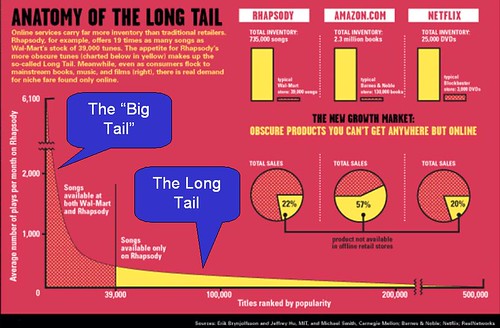
Events are in many ways a classic long-tail business. I have a bunch of spreadsheets where I try to calculate how many public events there are in a given metro area (the Bay Area, being home, is most often subject to such numerical indignities) and at some point, the hapless Excel hacker has to throw up his hands. Rolling Stones concerts and 49ers football games are easy to count. Bands at local bars are easy to count.
But what about implicit events, like the opening hours of the local go-kart race track? Is that an event? What about the daily classes at 6pm at Hot Yoga 101 or Fred's Karate Studio? They are scheduled for a certain time, or available any time; they are activities "to do" - the public can walk in and pay a fee - are they events? And then let's look at that 49ers game. Maybe 50,000 people get tickets. Maybe a million watch it on one of several local Bay Area TV stations. So one physical event generates multiple virtual events. 150 local bars have "49ers game Sunday" special events. Add 150 more. 15,000 fans throw "49ers game at my house" parties. Add those as well, though we begin to cross the threshold from public to private events.
When one adds all of these up -- and throws in the Meetups, the radio-controlled airplane club meetings, the church services, the Alcoholics Anonymous meetings, the extension courses at local universities, the City Council of Sunnyvale public forum for comment on the new library... I consistently get numbers like 50,000 events a week in the Bay Area. Can you say Long Tail?
But Long Tail isn't enough -- there's the Big Tail, too. The reason that Rolling Stones concerts and 49ers games and movie listings make it into the San Francisco Chronicle and the San Jose Mercury News, with their limited print space and their expensive distribution model, is that they are wide-swathe high-popularity events that many paying customers care deeply about. And when folks are trying to figure out what to do on a Wednesday night, dinner and a movie is very often their first and best choice.
Figuring out the right mix of Long Tail + Big Tail is a huge business opportunity in events, as it is in many other fields of commerce. I'm pretty excited about what we're doing at Zvents, and I look forward to showing the world and getting your feedback in (gulp!) less than a month.
The problem with MP3.com was that it was only Long Tail. It didn't have license agreements with the labels to offer mainstream fare or much popular commercial music at all. Therefore, there was no familiar point of entry for consumers, no known quantity from which further exploring could begin.Here's a modded graphic from the article:
Events are in many ways a classic long-tail business. I have a bunch of spreadsheets where I try to calculate how many public events there are in a given metro area (the Bay Area, being home, is most often subject to such numerical indignities) and at some point, the hapless Excel hacker has to throw up his hands. Rolling Stones concerts and 49ers football games are easy to count. Bands at local bars are easy to count.
But what about implicit events, like the opening hours of the local go-kart race track? Is that an event? What about the daily classes at 6pm at Hot Yoga 101 or Fred's Karate Studio? They are scheduled for a certain time, or available any time; they are activities "to do" - the public can walk in and pay a fee - are they events? And then let's look at that 49ers game. Maybe 50,000 people get tickets. Maybe a million watch it on one of several local Bay Area TV stations. So one physical event generates multiple virtual events. 150 local bars have "49ers game Sunday" special events. Add 150 more. 15,000 fans throw "49ers game at my house" parties. Add those as well, though we begin to cross the threshold from public to private events.
When one adds all of these up -- and throws in the Meetups, the radio-controlled airplane club meetings, the church services, the Alcoholics Anonymous meetings, the extension courses at local universities, the City Council of Sunnyvale public forum for comment on the new library... I consistently get numbers like 50,000 events a week in the Bay Area. Can you say Long Tail?
But Long Tail isn't enough -- there's the Big Tail, too. The reason that Rolling Stones concerts and 49ers games and movie listings make it into the San Francisco Chronicle and the San Jose Mercury News, with their limited print space and their expensive distribution model, is that they are wide-swathe high-popularity events that many paying customers care deeply about. And when folks are trying to figure out what to do on a Wednesday night, dinner and a movie is very often their first and best choice.
Figuring out the right mix of Long Tail + Big Tail is a huge business opportunity in events, as it is in many other fields of commerce. I'm pretty excited about what we're doing at Zvents, and I look forward to showing the world and getting your feedback in (gulp!) less than a month.
Friday, July 29, 2005
Cringely on Skype: Wrong, wrong, wrong
It's not very often that Robert Cringely gets *everything* wrong in a column, because he's a really smart guy. But his recent piece on Skype comes close to being a strikeout.
Let's take these one by one :
"So what's most interesting about News Corp. and Skype isn't that the deal fell through, but that News Corp. even knew Skype was available."
In case no one has noticed, communications and media are merging. In particular, Barry Diller over at IAC sees this happening. Is Match a media property, or a structured medium of communication between single people? Ummm, both. The last peer-to-peer client (Kazaa) that the Skype founders did was for distributing paid content (music), whereas Skype distributes free user-created content (voice calls and text messages). Is one of those a media company and one of thos a communications company, with a big bright line between the two? Kind of blurry, huh? If I were Rupert Murdoch, I'd not only know this convergence by heart, I'd be watching Diller like a hawk, which means I'd be all over this space.
"Since Skype service requires broadband, and broadband so far is inherently fixed, Skype threatens only incumbent FIXED phone service, not mobile service..."
Skype is based on the Global IP Sound (GIPS) codec. GIPS is the magic inside Skype that gives it its incredible ability to overcome latency, packet loss, jitter, and all the other crappy data delivery realities of the Internet. If you go to the GIPS website, you can hear a very nice demo of their sound quality over "telephony bandwidth" which is plenty narrow enough (8Kbps if I recall correctly) to fit within a GPRS channel. GPRS usually has waaay to much latency to work well for packet voice, but EV-DO? Absolutely.
And if that's not convincing enough, I have it on pretty good authority that a major CE manufacturer might be selling some Skype-enabled mobile devices in the not-far-distant future. Which they aren't doing because "Skype requires fixed broadband."
"Expect Skype to be sold, another viral marketing success sucked up by big business. Expect it to go to either a major broadband provider or, more likely, to a big mobile carrier with no fixed telephone assets."
I don't have any inside information on this point, but I can see that Skype is most attractive to Yahoo and Google and Microsoft and IAC and... NewsCorp, I guess, given that they're now buying web properties. All these guys get that communications+media = the future, because media is professional content and communications is user-created content and their combination is the "architecture of participation" which is Web 2.0. Why doesn't Cringely get this? He's got all the pieces in front of him.
"Of course, the rest of the VoIP industry loves this. If Skype is worth $3 billion, then so is Vonage and maybe Packet8."
Oh, puh-leez.
Firstly, let's look at cost base. Since Vonage doesn't use a decent codec like GIPS, they have been required to build out POPs across their targeted territories in order to get their calls off the public internet and onto their private low-latency high-quality backbone as soon as possible. This is an *enormously* expensive process similar to building a traditional telco network. Vonage also offers a physical box (CPE) that you plug your phone into, which means it is in the business of procuring, mailing, and managing hardware that has a BOM in the range of $60 to acquire every new customer. So both in capex and opex, Vonage has huge costs that Skype simply does not have. I don't know about Packet8's backbone, but their CPE situation is identical. So either should have a massively deflated value when compared to Skype, which requires only a software download (very low cost) and no network buildout for its "core product" of Skype to Skype calls. Incidentally, this is why Skype has 120 million people who've downloaded its client and Vonage and Packet 8 are in the single-digit millions at best. Skype does need POPs to do In/Out to the phone network, but that is a very different cost dynamic than what Vonage has to do simply to be in business.
Secondly, let's look at user experience. I have tried both Vonage and Packet8, and I have cancelled both because neither worked well enough to use, on Sand Hill Road right in the middle of Silicon Valley. This was due to some problems with my DSL line (thanks, SBC), but ultimately both solutions failed. Skype, on the other hand, works almost magically well. Recently I was in Chamonix in the French Alps, sitting on a plaza in front of the tourist office, using their free WiFi, and talking to (in succession) several foreign countries including the U.S., 6500 miles away.
Skype is unique in the VoIP, and while they may be bought by a smart network provider such as Comcast, my prediction is that they'll be snapped up by one of the usual-suspect next-generation communications+media companies, or as I should start calling them, "Extended Conversation" companies. I heard a rumor yesterday that Skype wanted $1 billion from Yahoo, and Yahoo offered $100 million. I don't know if any of that is true, but it sounds a lot more reasonable than anything Cringely is saying on this subject.
And someone really smart should buy Global IP Sound.
Wednesday, July 20, 2005
On Vacation, 2005 style
In case you can't tell from the decline of blogging volume, I've been on vacation these past two weeks. I've been climbing mountains, among other things: These shots are from Andrea and my summit of Mt. Blanc (with Alex and Jono, rock on guys!) last week in Chamonix.

I'm now in Prague with some great folks, and will be "back at work" soon. Which is good, because things are hoppin' back at the Galactic HQ, which I know because vacation, 2005, is not vacation, 2001, or even vacation, 2003.
This time, my cell phone works in Europe. No more lugging the old London Motorola Timeport, and no more buying Orange SIM cards and calling all my friends so they have the number. Want to talk? Call me.
This time, WiFi is everywhere. It was free in Chamonix. It was free from my friends in London. It is so cheap as to practically be free here in Prague.
And oh my god, Skype has arrived. I can't even count how many calls I have done on Skype. It's really is so cheap it's effectively free -- I can't remember when I put my 10 Euros for Skype Out in, and it's just worked and worked and worked.
Since I have been in Europe I have electronically talked to people in:
Japan
India
Greece
Serbia
England
The Czech Republic
and of course the USA. I have worked at least an hour every day (except when we summited Mt. Blanc) and a lot more on some days. The ability to be in touch is incredible -- I have successfully juggled two or three different major threads of activity, and still taken time to relax and actually *be* on vacation.
The world is gonna change a lot more real soon now, but it's worth stopping to recognize just how much it has changed in the past 24 months.
Friday, July 08, 2005
Citizen Media 2: The future is concentrated in... Worcester, Mass.?!!
I'll restate the William Gibson paraphrase (not exact quote) from the last post: "The future is here, it's just not evenly distributed yet."
I've posted about Peter Caputa and his excellent blog a couple times -- after swapping a few emails with him, and poking around his extended network over there in Worcester, Mass., I started to see some strange attractor kind of activity.
Firstly, there's the Wormtown Nightlife, a small e-zine sort of publication that has a very Web 2.0 mashup sort of feel to it -- with apartment listings from Craigslist, and events from Whizspark, and all sortsa nice features.
Then Peter started blogging about local bloggers getting print syndication -- which is a seriously hot topic in our own offices, except we tend to think more about print guys building blog audiences on the side -- kinda like Dan Gillmor, The Man Hisself, did.
Then I found this cool little dealie called blogfortickets which, surprise surprise, is a way of getting local bloggers (in Worcester, natch) to publicize an event in exchange for free tickets to that event -- pretty much the unspoken quid pro quo model of the entire access-for-exposure cultural media business, all the way from Vanity Fair magazine and their Oscar party down to your local alternative paper beat reporter plugging his friend's band and scoring a free drink token at their next gig.
And needless to say, when you dig into a "case study" on the blogfortickets site, you are greeted by the cosmic confluence of all things New Media Worcester:
So a quick question to the Worcester crew, since it's pretty clear you all know each other:
How do you deal with the old media of Worcester? Besides saying that their site sucks, I mean. The Worcester Telegram and Gazette is owned by the New York Times, has a circulation in excess of 100,000, and has lots of events nicely organized on its site. It's one of the top 100 papers in America. The Worcester magazine may have site issues, but they've got lots of great content, too.
So how does new media interact with old? Trumping it? Joining it? Circumventing it? You guys seem to have boiled the future into a nice tasty concentrated concoction over there -- what's it taste like?
I've posted about Peter Caputa and his excellent blog a couple times -- after swapping a few emails with him, and poking around his extended network over there in Worcester, Mass., I started to see some strange attractor kind of activity.
Firstly, there's the Wormtown Nightlife, a small e-zine sort of publication that has a very Web 2.0 mashup sort of feel to it -- with apartment listings from Craigslist, and events from Whizspark, and all sortsa nice features.
Then Peter started blogging about local bloggers getting print syndication -- which is a seriously hot topic in our own offices, except we tend to think more about print guys building blog audiences on the side -- kinda like Dan Gillmor, The Man Hisself, did.
Then I found this cool little dealie called blogfortickets which, surprise surprise, is a way of getting local bloggers (in Worcester, natch) to publicize an event in exchange for free tickets to that event -- pretty much the unspoken quid pro quo model of the entire access-for-exposure cultural media business, all the way from Vanity Fair magazine and their Oscar party down to your local alternative paper beat reporter plugging his friend's band and scoring a free drink token at their next gig.
And needless to say, when you dig into a "case study" on the blogfortickets site, you are greeted by the cosmic confluence of all things New Media Worcester:
There's gold in them thar hills, I think...The Event: South End Style
The Task: To help generate online buzz for South End Style by co-ordinating local bloggers to talk up and talk about the event on their blogs. In exchange for their time, bloggers would be given free passes to the event (normally $75)
The Players: Buck Paxton, Duncan Arsenault, Peter Caputa, Volcano Boy, LinneaDates, Andrew Teman, Amy Linny, WormtownNightlife
The Results: Blog for tickets mobilized quickly to take the buzz to the blogs. A WhizSpark event site was created for South End Style to act as the central landing spot for all outgoing blog links. This event website, unlike the main event sponsored site, included special instructions to those who reached the site via blogs…mention the code weblog and receive a free drink ticket with event ticket purchase.
To aid in the process, participating bloggers were given a variety of banners and images, as well as a snippet of information to use in their posts to help them get started. They were each asked to create a post talking up the event in their own way, and linking to the WhizSpark event site. The effect was swift and firm, as word of South End Style permeated the web, creating the buzz that the client was looking for. Last minute ticket sales spiked from word of mouth and online buzz created by the BlogForTickets crew and the event was a success.
So a quick question to the Worcester crew, since it's pretty clear you all know each other:
How do you deal with the old media of Worcester? Besides saying that their site sucks, I mean. The Worcester Telegram and Gazette is owned by the New York Times, has a circulation in excess of 100,000, and has lots of events nicely organized on its site. It's one of the top 100 papers in America. The Worcester magazine may have site issues, but they've got lots of great content, too.
So how does new media interact with old? Trumping it? Joining it? Circumventing it? You guys seem to have boiled the future into a nice tasty concentrated concoction over there -- what's it taste like?
Citizen Media 1: Bombs in London
I live in London, Al Qaeda bombs America. I live in America, Al Qaeda bombs London. So far, I seem to be living life by Ted Williams' maxim, "Hit 'em where they ain't."
Speaking of where they ain't, traditional media can't be everywhere -- but ordinary people can, and are, and increasingly can record and report on what happened. The Washington Post was so surprised that people would actually use cameraphones to take pictures that they wrote two more or less identical pieces on the same subject, and then threw in a gallery of cameraphone images for good measure. Some decent analysis in the second piece -- Robert Macmillan nails the point that this is simultaneously no different from the Zapruder film, and entirely different from anything that has gone before.
Interestingly, history has always had the jump on the news media for citizen participation -- while in the past two centuries it's been hard for individuals to compete with the speed and long-distance capabilities of news, the humble letter or personal account is often the core document from which history is constructed in all its textured glory and narrative magnificence.
Dan Gillmor is right -- we are on the cusp of being able to report the news ourselves as it happens, across all media (audio, visual, textual) and this is going to change the existing channels of information tremendously.
However, we still have a long way to go -- hats off to Technorati for trying, but this falls short of the precise conveyance of information that I get from the New York Times; but Flickr did a great job of highlighting recent tags like londonbombblasts.
To quote William Gibson, the future is here, it's just not evenly distributed yet.
Friday, July 01, 2005
Citizen Journalist: Chris Allbritton in Iraq
People interested in "citizen journalism" and user-created content should check out the blog:
http://www.back-to-iraq.com/ where Chris Allbritton has been traipsing around Iraq supported by readers:
I had believed that regardless of the blog-driven forthcoming split between editorial and reporting at the major news organizations, it would be these organizations that would continue to have the near-monopoly ability to fund and maintain an extensive news-gathering presence around the world. Chris' work suggests that this belief may already be out of date.
Bonus food for thought: We all can see that our current news-gathering system is getting manipulable and corrupted beyond belief, and increasingly its authority and credibility are shot. Wouldn't it be interesting if a new form of reporting, based on a new form of trust and credibility -- socially established, not oligopoly-brand-based -- emerged, phoenix-like, from the ashes of the old?
http://www.back-to-iraq.com/ where Chris Allbritton has been traipsing around Iraq supported by readers:
In March 2003, I made it back in time for the war, becoming the Web's first fully reader-funded journalist-blogger. With the support of thousands of readers, we raised almost $15,000. You can read my dispatches here. It was one of the moments in journalism when everything worked. It was a grand -- and successful -- experiment in independent journalism.Here's a sample of his writing:
“Bumps in the road”? Just earlier today, presumably before the Iraqi journalist was killed, an Iraqi member of parliament was killed in a car bomb attack. I can't even begin to tell you how many Iraqis have been killed in the weeks I was away. And how many more Iraqis, journalists or otherwise, will die because the Americans can't tell who's friend or foe? Those aren't “bumps in the road.” Those are signs that you went off the road without a map a long time ago...
News flash: Iraq is a disaster. I've been back one day, and the airport road was the worst I've ever seen it. We had to go around a fire-fight between mujahideen and Americans while Iraqi forces sat in the shade of date palms on the side of the road, their rifles resting across their laps. My driver pointed to a group of men in a white pickup next to me. “They are mujahideen,” he said. “They are watching the Americans.” Indeed, they were, and so intently that they paid no attention to me in the car next to them. We detoured around two possible car bombs that had been cordoned off while Iraqis cautiously approached.
Rumsfeld's assessment of “good progress” on the constitution is not accurate... [Morale] wasn't rock-bottom among the Marines of the 1st Battalion, 5th Marine Regiment, but it wasn't great. Most of the ones I talked to weren't confident they were doing anything worthwhile, and were instead focused on getting home alive. If a few Iraqis had to die to make that happen, well, war is hell.
I'm not sure who's winning this war, the Americans or the insurgents. But I know who is losing it: the Iraqi people. Those bumps in the road are their graves.
Highly recommended.I had believed that regardless of the blog-driven forthcoming split between editorial and reporting at the major news organizations, it would be these organizations that would continue to have the near-monopoly ability to fund and maintain an extensive news-gathering presence around the world. Chris' work suggests that this belief may already be out of date.
Bonus food for thought: We all can see that our current news-gathering system is getting manipulable and corrupted beyond belief, and increasingly its authority and credibility are shot. Wouldn't it be interesting if a new form of reporting, based on a new form of trust and credibility -- socially established, not oligopoly-brand-based -- emerged, phoenix-like, from the ashes of the old?
Events, News, Local Media
Tyler drops me an email, saying "Caputa has been drinking from our coffee pot."
As an aside, Tyler will be starting his own blog soon. I am fearful that many posts will be of the approximate form, "Ethan and I had this great conversation, he went off to blog about it, and now my task list is two days longer."
This is a fantastically good post by Peter. In addition to the best graphical design and the best blog figurehead in the (granted, small) dudes-starting-an-events-company space, his thinking is really first-rate. And yes, we'd like to help build "that" -- and a heck of a lot more besides!
So let me address a few points:
"We're not talking micro-formats. We're not talking who can get the biggest pile of events. We're talking about leveraging events to build community."
Absolutely agree. As much as I admire Dave and the Technorati crew, they at present seem to have a "one big pile" theory of the Web that is decidedly un-community. In a previous post I suggested that while their Live8 page implies that they may be getting media (and their recent hiring of the exceedingly bright Peter Hirshberg is another big clue) but I am still not sure that they get local media in the slightest. Local media is not one big pile -- it is a lot of little piles, right down to the happy little sandboxes of communities and individual people. Microformats are designed to enable the "one big pile" method of media, and Google News shows how well that works. Not.
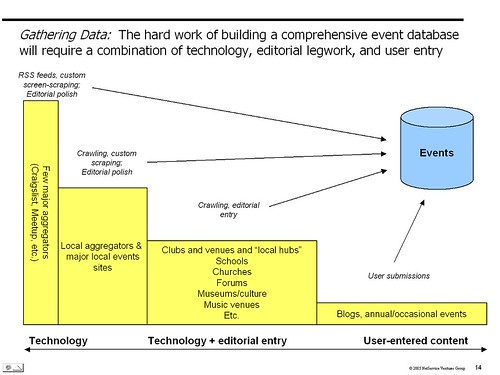
However, *someone* (or someones) needs to put together a big pile of events, because that is the grist for the mill that will make this new media go. There are only three (OK, 3 1/2) ways this can be done:
1) People enter the events themselves. As a .5 addendum, individual users like clubs, museums, and the marketing secretary of the San Francisco Symphony enter the events themselves. The shopping sites (Shopzilla, Pricegrabber) have evolved their models to high levels of participation by their data sources/merchants.
2) Some reportorial/editorial/data staff at some "publication" in this new world enters the events themselves.
3) Some magically delicious techno-spider crawls the web and devours reams of prose, spitting out all the gruel and swallowing the crunchy event bits, which are polished to DBMS perfection by its extraordinary digestive tract.
If we look at "old media" like, say, the Pink Pages in the SF Chronicle, (handily reproduced in data form at SFGate) they are getting their events through a combination of 1) and 2). Technorati, with its microformats push, hopes to get events purely through 3). I think that all of us in this space should, right now, face up to the fact that probably it will be some combination of all three.
And I think that we should further promise that if we are ever sitting at some future panel at some future conference we should not, not, not, snipe back and forth about "editorial is better" or "techno-spiders rule" like the mind-numbing WiFi vs. CDMA panel I sat through at CES last February. It's a combination of these, OK? Pax.
Hey, look, I even have a slide on this -- and even better, it includes a long tail! No Rip van Winkel blogging here, nosiree.
"We can create a template for a Sunday football game and let 50 sports bar owners use it to organize Sunday night 2 dollar draft parties at their bar."
Yeah! Right on! Forget 50 -- how about 5000? Heck, there are reportedly 10,000 bars in Wisconsin alone. (I can't find the link 'cause I heard it on NPR). All those guys need is a template, and their local venue information... and some cardinal event representation of "the Super Bowl" to point to.
Now that "cardinal representation" is where things get dicey, but I'll have to leave that for another post. Because we have all learned from Google that there are several kinds of truth, namely statistical, absolute, network-social, and "Sergey said so." Is this the cardinal site for the Superbowl? Or is it someone else's potentially far better site? Is an autobiography the most authoritative source on a politician's life? Hmm. Again, 'nother post for more on that.
"Now think of all of the events that are happening. And then realize that events are ALWAYS happening. There are always events. New ones."
Peter, you are so on the money! But let's take this one teeny weensy step further. What are all these new things that are happening? Well, there are expected things (events) and there are unexpected things (which, I suppose, can also be called events, but only after they happen). When you take all the expected things that are gonna happen, and you take all the unexpected things that just happenened, and you talk about these things in some vaguely structured format supported by a revenue stream, what do you got?
Ye gods.
Again, previous post:
"The three legs of local media are 1) reporting 2) editorial and 3) advertising."
Reporting about what? Events (future) and unexpected things (recent past).
Editorializing about what? Events (future) and unexpected things (recent past).
Advertising? Oh yeah, billions of dollars of it.
Events are so where it's at.
Final point from Peter:
"Create a site for the Olympics and aggregate what everyone is saying around it, pictures people are taking, etc. Create the unofficial (or official) site for the event, and benefit from its buzz."
I'm guessing that Peter means "a virtual site like Technorati did for Live8." Because in the present web reality, creating a site is already an exercise in virtualization, currently phrased as "mashup." And in the emerging 2.0 future, we won't even be able to do that -- all our readers/writiers/participators/eyeballs/hands/heads/hearts/"fellow inhabitants of What's Next" are going to be RSSing and ATOMing and creating their own virtualization of us... which means that we'll have to do things ever so slightly differently.
More on that in a month or two. And tomorrow, I'll expand on Peter's final point about "revenue stream from site-building" and discuss my theory of MySpace as a music-blogging site a bit more. If Tyler doesn't hit me with the coffeepot.
As an aside, Tyler will be starting his own blog soon. I am fearful that many posts will be of the approximate form, "Ethan and I had this great conversation, he went off to blog about it, and now my task list is two days longer."
This is a fantastically good post by Peter. In addition to the best graphical design and the best blog figurehead in the (granted, small) dudes-starting-an-events-company space, his thinking is really first-rate. And yes, we'd like to help build "that" -- and a heck of a lot more besides!
So let me address a few points:
"We're not talking micro-formats. We're not talking who can get the biggest pile of events. We're talking about leveraging events to build community."
Absolutely agree. As much as I admire Dave and the Technorati crew, they at present seem to have a "one big pile" theory of the Web that is decidedly un-community. In a previous post I suggested that while their Live8 page implies that they may be getting media (and their recent hiring of the exceedingly bright Peter Hirshberg is another big clue) but I am still not sure that they get local media in the slightest. Local media is not one big pile -- it is a lot of little piles, right down to the happy little sandboxes of communities and individual people. Microformats are designed to enable the "one big pile" method of media, and Google News shows how well that works. Not.
However, *someone* (or someones) needs to put together a big pile of events, because that is the grist for the mill that will make this new media go. There are only three (OK, 3 1/2) ways this can be done:
1) People enter the events themselves. As a .5 addendum, individual users like clubs, museums, and the marketing secretary of the San Francisco Symphony enter the events themselves. The shopping sites (Shopzilla, Pricegrabber) have evolved their models to high levels of participation by their data sources/merchants.
2) Some reportorial/editorial/data staff at some "publication" in this new world enters the events themselves.
3) Some magically delicious techno-spider crawls the web and devours reams of prose, spitting out all the gruel and swallowing the crunchy event bits, which are polished to DBMS perfection by its extraordinary digestive tract.
If we look at "old media" like, say, the Pink Pages in the SF Chronicle, (handily reproduced in data form at SFGate) they are getting their events through a combination of 1) and 2). Technorati, with its microformats push, hopes to get events purely through 3). I think that all of us in this space should, right now, face up to the fact that probably it will be some combination of all three.
And I think that we should further promise that if we are ever sitting at some future panel at some future conference we should not, not, not, snipe back and forth about "editorial is better" or "techno-spiders rule" like the mind-numbing WiFi vs. CDMA panel I sat through at CES last February. It's a combination of these, OK? Pax.
Hey, look, I even have a slide on this -- and even better, it includes a long tail! No Rip van Winkel blogging here, nosiree.
"We can create a template for a Sunday football game and let 50 sports bar owners use it to organize Sunday night 2 dollar draft parties at their bar."
Yeah! Right on! Forget 50 -- how about 5000? Heck, there are reportedly 10,000 bars in Wisconsin alone. (I can't find the link 'cause I heard it on NPR). All those guys need is a template, and their local venue information... and some cardinal event representation of "the Super Bowl" to point to.
Now that "cardinal representation" is where things get dicey, but I'll have to leave that for another post. Because we have all learned from Google that there are several kinds of truth, namely statistical, absolute, network-social, and "Sergey said so." Is this the cardinal site for the Superbowl? Or is it someone else's potentially far better site? Is an autobiography the most authoritative source on a politician's life? Hmm. Again, 'nother post for more on that.
"Now think of all of the events that are happening. And then realize that events are ALWAYS happening. There are always events. New ones."
Peter, you are so on the money! But let's take this one teeny weensy step further. What are all these new things that are happening? Well, there are expected things (events) and there are unexpected things (which, I suppose, can also be called events, but only after they happen). When you take all the expected things that are gonna happen, and you take all the unexpected things that just happenened, and you talk about these things in some vaguely structured format supported by a revenue stream, what do you got?
NEWS.
Ye gods.
Again, previous post:
"The three legs of local media are 1) reporting 2) editorial and 3) advertising."
Reporting about what? Events (future) and unexpected things (recent past).
Editorializing about what? Events (future) and unexpected things (recent past).
Advertising? Oh yeah, billions of dollars of it.
Events are so where it's at.
Final point from Peter:
"Create a site for the Olympics and aggregate what everyone is saying around it, pictures people are taking, etc. Create the unofficial (or official) site for the event, and benefit from its buzz."
I'm guessing that Peter means "a virtual site like Technorati did for Live8." Because in the present web reality, creating a site is already an exercise in virtualization, currently phrased as "mashup." And in the emerging 2.0 future, we won't even be able to do that -- all our readers/writiers/participators/eyeballs/hands/heads/hearts/"fellow inhabitants of What's Next" are going to be RSSing and ATOMing and creating their own virtualization of us... which means that we'll have to do things ever so slightly differently.
More on that in a month or two. And tomorrow, I'll expand on Peter's final point about "revenue stream from site-building" and discuss my theory of MySpace as a music-blogging site a bit more. If Tyler doesn't hit me with the coffeepot.
Thursday, June 30, 2005
Open Letter: Del.icio.us major UI issue
I love Del.icio.us. I wish Joshua Schachter all the best, and as I understand it, "the best" means everyone using his wonderful creation.
Joshua, can you please, please fix one UI problem that is (I suspect) costing you thousands of users and hundreds of thousands of uses every day?
How life should work:
When I go to Google, and I want to find something, I find a box that has a blinking cursor in it, and a grey button titled "Google Search". Unless I am waaaaaay behind the curve, it dawns on me (me being the zero-sigma Internet user) that perhaps I should type what I want, and click "Google Search" or even (gasp!) press (Enter).

How Del.icio.us works:
When I go to Del.iciou.us, what do I see?
1) A big list of tagged items that I may care nothing about
2) A list on the right side of "most popular" that I probably care at least slightly about
3) A few mysterious text links in the top-right: "bookmarks index post settings about"

How do I find something?
I dunno.
Oh, it turns out, I go up to the URL entry field on my *browser* and type /tag/something to get what I want. And if I want "interesting blog" then I tyle /tag/interesting+blog.
Gee, that was obvious!
What if I want to see someone's bookmarks? Again I go to the browser's URL entry field, and add /onohoku/ or /fred/ or whatever (there seems to be no fred or john on del.icio.us... but of course there's an /ethan/...miller... we Ethans are early adopters!
Now this being Web 2.0, of course I could hack together my own bad-ass interface for del.icious and release it to the world. But that would not solve the core problem, which is that right now, some frustrated del.icio.us newbie is going to the main site, laden with glorious potential, and clicking away frustrated because he damn well can't figure out how to *get what he wants*.
Can we please, please, have a text entry box or two? Or even (gasp) a single line of text explanation of how to get what we want?
It will make the tagging universe grow *ever* so much faster...
Thanks.
Joshua, can you please, please fix one UI problem that is (I suspect) costing you thousands of users and hundreds of thousands of uses every day?
How life should work:
When I go to Google, and I want to find something, I find a box that has a blinking cursor in it, and a grey button titled "Google Search". Unless I am waaaaaay behind the curve, it dawns on me (me being the zero-sigma Internet user) that perhaps I should type what I want, and click "Google Search" or even (gasp!) press (Enter).
How Del.icio.us works:
When I go to Del.iciou.us, what do I see?
1) A big list of tagged items that I may care nothing about
2) A list on the right side of "most popular" that I probably care at least slightly about
3) A few mysterious text links in the top-right: "bookmarks index post settings about"
How do I find something?
I dunno.
Oh, it turns out, I go up to the URL entry field on my *browser* and type /tag/something to get what I want. And if I want "interesting blog" then I tyle /tag/interesting+blog.
Gee, that was obvious!
What if I want to see someone's bookmarks? Again I go to the browser's URL entry field, and add /onohoku/ or /fred/ or whatever (there seems to be no fred or john on del.icio.us... but of course there's an /ethan/...miller... we Ethans are early adopters!
Now this being Web 2.0, of course I could hack together my own bad-ass interface for del.icious and release it to the world. But that would not solve the core problem, which is that right now, some frustrated del.icio.us newbie is going to the main site, laden with glorious potential, and clicking away frustrated because he damn well can't figure out how to *get what he wants*.
Can we please, please, have a text entry box or two? Or even (gasp) a single line of text explanation of how to get what we want?
It will make the tagging universe grow *ever* so much faster...
Thanks.
Wednesday, June 29, 2005
Google Maps API is launched
Read about it here. In my last post I talked about Google and Yahoo trading punches - well, I think that Google is landing fewer but bigger shots. Google Maps is a roundhouse, and until Microsoft launches their TerraServer product as Virtual Earth on MSN (supposedly launching any moment at Where 2.0) Google Maps is the standard. There are already all sorts of cool mashups out there, and now that the API is out, this will explode. Um, where is Yahoo on this?
Subscribe to:
Posts (Atom)