Wednesday, October 05, 2005
Web 2.0: It's just a conference
I've been to quite a few conferences, and both for the ones I've attended and the ones I haven't, there's often this feeling as the time draws near that This is the Center of the Universe, and Great Things Will Occur. Well, it usually turns out that a conference is just a conference. Great things may occur -- you're seeing an enormous conncentration of activity timed to these three days, including the launch of Zvents -- but that isn't really happening "at the conference". I just sat through my first workshop session (never mind which one) where I saw some really smart guys present (with moderate success) some software that they've worked really hard on. This will be repeated, ad infinitum, for the next three days, with occasional wonk-fests about XML over HTTP, and at least one great moment that would have been great to see, if it hadn't cost so damn much to me bere. So even if this is the center of the universe, (a doubtful proposition at best) I keep reminding myself, the universe is a very large place.

Zvents Launches!
We turned on the lights at Zvents at ~2 am Pacific time last night. No passwords, no beta. Five minutes later, we had our first registration. Web 2.0 is cool. So I actually got a little sleep before the Web 2.0 conference started. The game’s afoot!
Tuesday, October 04, 2005
It's all happening! Yahoo buys Upcoming.org
Yahoo buys Upcoming.org.
Paul Levine and the folks over at Yahoo! Local are very smart. They've demonstrated that yet again with their focus on the social aspects of events and the opportunity to integrate in with personal content (360) groups (Y! Groups) and the extensive set of venues in Y! Local. This is a nice integration element for them, and Andy and team are a great fit. This space gets hotter every day - and Zvents launches tomorrow!
Events are a particularly exciting area of human knowledge -- chock full of rich local, social, and temporal data. People want to find out what's going on near them, know what their friends are seeing and doing, and plan their outings. And they want to do it when they want, wherever they are, on any device, in a way that's relevant to them.
Paul Levine and the folks over at Yahoo! Local are very smart. They've demonstrated that yet again with their focus on the social aspects of events and the opportunity to integrate in with personal content (360) groups (Y! Groups) and the extensive set of venues in Y! Local. This is a nice integration element for them, and Andy and team are a great fit. This space gets hotter every day - and Zvents launches tomorrow!
Monday, September 26, 2005
So what *is* the payment model for Web 2.0?
This is increasingly the most important question around. I started noodling on this in my last post, and Blogsicle really lays it out in this post:
BTW Blogsicle is a smart blog I found via Peter Caputa. Update: I've since swapped emails with Peter Brown, the man behind Blogsicle, and can put a name to the blog.
So how does this work? Capitalism works by people paying other people money. One of the reasons that Capitalism 1.0 had a very large granularity (meaning relatively few big companies) is that electronic payment systems were very expensive and non-electronic payment systems (cash and checks) were even more expensive. Micropayments died about twenty times. Web 1.0 (call it capitalism 1.1) saw the innovation of cheapER payment systems like PayPal, which enabled companies like eBay to get reasonably large (still nothin' on WalMart or GE). But they still ain't cheap, and they are still far from automatic. And oh yeah, they still rely on a platform of bank accounts and credit cards and other Capitalism 1.0 kind of expensive bits and pieces.
So if Zvents has an event in it (say, an NFL football game), and someone finds it via Technorati, who serves them an ad about a related event (say, a charity benefit before the game) that WhizSpark is hosting the PR for, and the user clicks on that ad, and ends up signing up for the $50 event, who gets what? And how is it different if they click through to Zvents from Technorati, and *Zvents* serves them that same ad from WhizSpark, and they sign up in the same way? Clearly the people who need to get paid here are:
Technorati
Zvents
Whizspark
The event host/promoter (the charity)
and possibly the "big event" host/promoter (the NFL team)
The way this happens in Capitalism 1.0 is a study in high friction. Ticketmaster goes and signs multi-year contracts with big venues. Big venues book touring acts months in advance. Ticketmaster buys advertising space in local media. It's all done with paper and signatures on multi-month timelines, and the granularity is tens of thousands of dollars in most cases.
In Web 2.0, the theory is that we can a) create a payment system that is low-enough cost that it can efficiently allocate that $50 among as many as five players and that b) such a system and its associated contracts, representations and warranties, fraud control mechanisms, return policies, and other necessary legal blother can all be rolled into some sort of open-market-like API so that Technorati, Zvents, and WhizSpark can all jointly work in this value chain.
That sounds like a Very Big Problem to me, that needs a Very Big Solution. PayPal? Google Payments? Some sort of open consortium? You tell me.
Oh but the economics! you say. Why would one group with a kick ass AJAX’d calendar app let out event data to a less-than-beautiful but popular community event aggregator? Why would I let you view all this in RSS? After all, you’re not seeing my google ads…
BTW Blogsicle is a smart blog I found via Peter Caputa. Update: I've since swapped emails with Peter Brown, the man behind Blogsicle, and can put a name to the blog.
So how does this work? Capitalism works by people paying other people money. One of the reasons that Capitalism 1.0 had a very large granularity (meaning relatively few big companies) is that electronic payment systems were very expensive and non-electronic payment systems (cash and checks) were even more expensive. Micropayments died about twenty times. Web 1.0 (call it capitalism 1.1) saw the innovation of cheapER payment systems like PayPal, which enabled companies like eBay to get reasonably large (still nothin' on WalMart or GE). But they still ain't cheap, and they are still far from automatic. And oh yeah, they still rely on a platform of bank accounts and credit cards and other Capitalism 1.0 kind of expensive bits and pieces.
So if Zvents has an event in it (say, an NFL football game), and someone finds it via Technorati, who serves them an ad about a related event (say, a charity benefit before the game) that WhizSpark is hosting the PR for, and the user clicks on that ad, and ends up signing up for the $50 event, who gets what? And how is it different if they click through to Zvents from Technorati, and *Zvents* serves them that same ad from WhizSpark, and they sign up in the same way? Clearly the people who need to get paid here are:
Technorati
Zvents
Whizspark
The event host/promoter (the charity)
and possibly the "big event" host/promoter (the NFL team)
The way this happens in Capitalism 1.0 is a study in high friction. Ticketmaster goes and signs multi-year contracts with big venues. Big venues book touring acts months in advance. Ticketmaster buys advertising space in local media. It's all done with paper and signatures on multi-month timelines, and the granularity is tens of thousands of dollars in most cases.
In Web 2.0, the theory is that we can a) create a payment system that is low-enough cost that it can efficiently allocate that $50 among as many as five players and that b) such a system and its associated contracts, representations and warranties, fraud control mechanisms, return policies, and other necessary legal blother can all be rolled into some sort of open-market-like API so that Technorati, Zvents, and WhizSpark can all jointly work in this value chain.
That sounds like a Very Big Problem to me, that needs a Very Big Solution. PayPal? Google Payments? Some sort of open consortium? You tell me.
Mergers, customers, and Web 2.0
In a recent post, I mused about the timeline on which mergers and consolidation take place within technology. I neglected an obvious point in that post, which is that a lot of these mergers are in the best interest of the vendors, but not in the best interest of their customers. It was pretty clear that Larry Ellison viewed the takeover of PeopleSoft as an opportunity to raise prices and reduce customer choice. It is pretty clear that Adobe and Macromedia merging will eliminate troublesome competition from both the web authoring tools and web content distribution space. None of this is very good for customers and users.
One of the precepts of Web 2.0 is that new technologies and standards like RSS, XML, and web services are going to allow flexible, customer-driven interoperability and integration -- "mashups" driven by customer desire for functionality rather than mergers driven by vendor desire for profitability. There are several assumptions built into this governing philosophy of Web 2.0:
a) That such mashups will actually work and add value - that the costs of integration really have fallen to the extent that you can effectively and usefully integrate at the desktop, not the boardroom.
b) That some sort of business model will emerge that would allow a convoy of solution elements like the ones posited by Peter to actually charge customers a reasonable fee, and split that revenue among themselves.
c) That vendors (that'd be us Web 2.0 companies) will not act in our own greedy short-sighted self-interest, but (perhaps because we are chastened by the threat of open-content examples like Wikipedia and, kind of, Craigslist) instead really allow our customers vast choice and freedom.
In order for Web 2.0 to work the way it's been hyped, all three of these have to come true. The existence of many mashups and the existence of Google AdSense are indications that a) and b) can happen, though they are very early, partial steps. C) remains entirely hypothetical for now, though it can be argued that Craiglist is an example.
I am really curious for others' thoughts on this.
News: Dan Brown to be Catholic Cardinal
Yahoo! Finance just did something really dumb. They hired Robert T. Kiyosaki, author of the best-selling Rich Dad, Poor Dad as a columnist for their new foray into editorial content. The only problem is that Kiyosaki is about the worst possible authority on finance and money managment that they could have chosen. It's like the Catholic Church reading The Da Vinci Code and deciding to make Dan Brown a cardinal.
Here's the press release:
In my opinion, Kiyosaki preys on the aspirations of struggling middle-class folks by feeding them baloney about how they can become rich. His financial advice is not just bad, it's downright dangerous to your financial health. I am sure that someone, somewhere, has gotten rich following his recommendations, but I am also sure that the vast majority of his readers are at best poorer by the cost of his book as the net result of their relationship with him.
I highly recommend John Reed's highly analytical takedown of Rich Dad, Poor Dad. I don't know Reed personally, but on the basis of this analysis alone, I would let him invest $100,000 of my money before I would give Kiyosaki $20.
Here's the press release:
SANTA MONICA, Calif.--(BUSINESS WIRE)--Sept. 26, 2005--Yahoo! Inc. (Nasdaq:YHOO), a leading global Internet company, today announced that Yahoo! Finance has launched a series of exclusive finance columns from nine of the nation's most respected authors, economists, and financial advisors. The columns will cover a range of personal finance topics, offer investment insights, and cover the most important economic trends and issues. The new Yahoo! Finance columnists include David Bach, Stephen Covey, Ken Dychtwald, Robert Kiyosaki, Daniel Pink, Laura Rowley, Jeremy Siegel, Ben Stein, and Charles Wheelan.
...Robert Kiyosaki is a best-selling author, investor, entrepreneur, and educator. In his column, "Why the Rich Get Richer," he will discuss why many commonly held truths about managing money are obsolete. His column will run every other Tuesday.
In my opinion, Kiyosaki preys on the aspirations of struggling middle-class folks by feeding them baloney about how they can become rich. His financial advice is not just bad, it's downright dangerous to your financial health. I am sure that someone, somewhere, has gotten rich following his recommendations, but I am also sure that the vast majority of his readers are at best poorer by the cost of his book as the net result of their relationship with him.
I highly recommend John Reed's highly analytical takedown of Rich Dad, Poor Dad. I don't know Reed personally, but on the basis of this analysis alone, I would let him invest $100,000 of my money before I would give Kiyosaki $20.
Saturday, September 24, 2005
Acquisition for exit, acquisition for profit
Peter Caputa has a new post up about potential consolidation in the calendars/time/events space. As usual, Peter's on to something, but as usual, he seems to want this all to happen at the speed of thought.
Let's have a reality check. Siebel Systems and Oracle just merged. This merger was pretty much foreordained when Tom Siebel left Oracle after a dispute with Larry Ellison about the relative value of databases and the applications built on top of databases. When was that? 1993. In the intervening 12 years, Siebel has built billions of dollars of value-added apps on top of databases, and to a large extent built its company with Oracle talent. This merger is a reunion that has always made sense, and yet it took a decade, because that's the kind of timeframe over which real business power and profit are sorted out.
There are other examples that are more complex, like Macromedia. Quoting from this site:
Let's see. That's seven years of operations before the first merger, and then five more mergers over six more years, ultimately leading to Macromedia owning Flash, which is pretty much why we all think of the firm. Now, of course, a further eight years later, Macromedia and Adobe have (finally?) merged, which, one could argue, made sense way back in 1984.
Patience, Peter. It'll all sort itself out. And as Kevin Hughes said to me the other day at CommerceNet as we discussed his great paper and events, "This market is wide open, and no one has figured it out yet."
Zvents is coming Real Soon Now!
Let's have a reality check. Siebel Systems and Oracle just merged. This merger was pretty much foreordained when Tom Siebel left Oracle after a dispute with Larry Ellison about the relative value of databases and the applications built on top of databases. When was that? 1993. In the intervening 12 years, Siebel has built billions of dollars of value-added apps on top of databases, and to a large extent built its company with Oracle talent. This merger is a reunion that has always made sense, and yet it took a decade, because that's the kind of timeframe over which real business power and profit are sorted out.
There are other examples that are more complex, like Macromedia. Quoting from this site:
Macromedia was formed in April 1992 by the merger of Authorware and MacroMind-Paracomp. Authorware began operations in 1987. Founded in 1984, MacroMind merged with Paracomp in 1991. Macromedia extended its vision further in January 1995, when it acquired Altsys, maker of FreeHand, the leading design tool for print and Internet graphics. In September 1995, Macromedia acquired Fauve Software, developer of xRes, the fast creative tool for imaging and the Internet. Macromedia acquired OSC Software, developer of Deck II, in November 1995 Macromedia acquired iband, developer of Backstage, in March of 1996. Most recently, in January 1997, Macromedia acquired FutureWave, developer of FutureSplash Animator which was relaunched as Macromedia Flash, the easiest way to create small, fast Shockwave multimedia.
Let's see. That's seven years of operations before the first merger, and then five more mergers over six more years, ultimately leading to Macromedia owning Flash, which is pretty much why we all think of the firm. Now, of course, a further eight years later, Macromedia and Adobe have (finally?) merged, which, one could argue, made sense way back in 1984.
Patience, Peter. It'll all sort itself out. And as Kevin Hughes said to me the other day at CommerceNet as we discussed his great paper and events, "This market is wide open, and no one has figured it out yet."
Zvents is coming Real Soon Now!
Friday, September 23, 2005
Proxy Fight Brewing Over MySpace
Who needs soap operas when you can watch blood n' guts drama in real life? Check this out! Anyone who's read the details of the Intermix/NewsCorp deal knows what a dog's breakfast that company is. The total employee ownership of MySpace is tiny - of the $500m+ deal, the founders only got a small fraction. I will be curious to watch this unfold.
Thursday, September 22, 2005
TechCrunch BBQ Meetup - It's All Happening
Just got back from the TechCrunch Meetup. Can I just say that the best way to arrive at any event is in Paul Martino's pimpin' ride, soundtrack and all.
Had lots of interesting chats with interesting folks. Demos were in the air:
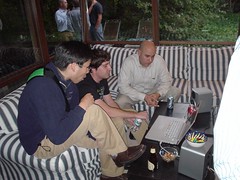
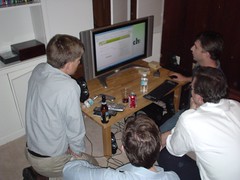
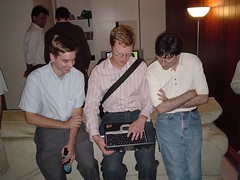
I am sure Michael will post details tomorrow over at TechCrunch.
It's all happening, folks!
[Tag: TechCrunchBBQ]
Had lots of interesting chats with interesting folks. Demos were in the air:
I am sure Michael will post details tomorrow over at TechCrunch.
It's all happening, folks!
[Tag: TechCrunchBBQ]
Wednesday, September 21, 2005
Events Search is Definitely in the Water
Zvents is days away from launch and a delightfully accomplished competitor has emerged. Check out BeThereBeSquare, which appears to be a one-man effort by Tim Martin. If so, I'd put him in the Bob Dylan class of one-man bands. Nice!
Kevin Hughes on Events
Intrigued by EVDB and Upcoming.org? Can't wait to see what Zvents is up to? Read Peter Caputa's blog?
Then you will definitely be interested in this: A way-smart paper by Kevin Hughes of CommerceNet, written one year ago, called "Event-Driven Information: A Core Component of the Now Economy." I just found this about a month ago, and was amazed at how Kevin had anticipated so much of our thinking at Zvents. I was so impressed that I'm headed over to talk shop with him later today. And with some people talking smack about who copied who, I thought I'd give a big shout out to a guy who published a lot of smart stuff first. Go. Read.
Then you will definitely be interested in this: A way-smart paper by Kevin Hughes of CommerceNet, written one year ago, called "Event-Driven Information: A Core Component of the Now Economy." I just found this about a month ago, and was amazed at how Kevin had anticipated so much of our thinking at Zvents. I was so impressed that I'm headed over to talk shop with him later today. And with some people talking smack about who copied who, I thought I'd give a big shout out to a guy who published a lot of smart stuff first. Go. Read.
Open-Source Ad Network vs. Slashdot's Proprietary Ads
So the big rumor that flew by at the VLab tonight is that there's an open-source ad network forming. Scott Rafer spoke at moderate length about how AdSense/Words and Overture are becoming big pieces of proprietary, complex, unmaintainable, inefficient code (not sure how much of that was rhetoric ;-) and it is clear that the Google and Yahoo ad networks lock a lot of people - publishers and advertisers both - into models that they don't necessarily best benefit from. So it was interesting to say the least that an open counterpoint appears to be forming.
It was claimed that John Battelle's FM Publishing, Feedster, Jason Calcanis' Weblogs Inc., and Mark Pincus' latest (currently known as TagBadge, I believe) will all use this network, which is based on the phpAdsNew ad server. Scott made the interesting point that Slashdot, Ground Zero for open source, uses DoubleClick to serve its ads, and "maybe they'll come under some pressure from the open source community to change that." Grin. Yeah, maybe they will. Down with Slashdot, closed-source enabler!
It was claimed that John Battelle's FM Publishing, Feedster, Jason Calcanis' Weblogs Inc., and Mark Pincus' latest (currently known as TagBadge, I believe) will all use this network, which is based on the phpAdsNew ad server. Scott made the interesting point that Slashdot, Ground Zero for open source, uses DoubleClick to serve its ads, and "maybe they'll come under some pressure from the open source community to change that." Grin. Yeah, maybe they will. Down with Slashdot, closed-source enabler!
Stanford VLab rumor roundup
This post is a bullpen for all the rumors and tidbits that flew by at the Stanford MIT VLab search event and don't get their own special post.

- Delight.com is launching a search service in a couple of weeks that, basically, will be search for women. I don't know what that looks like, but a good guess would be the search equivalent of delight.com. Lynda Keeler, who also launched LA.com, is apparently expanding her media-savvy ways toward more search functionality. Stay tuned.
- Barney Pell, currently an EIR at Mayfield, told a great story about Snap.com, which he is advising. When they first launched Snap, they discovered that their users skewed much older than average web demographics. They got ahold of some of these people and asked them, "why are you using the site?" The response was, "Because your fonts are big. All those other sites use tiny fonts and I can't read them." So Snap is launching big.com whose value proposition is simple: "The Most Readable Results on the Web."
- Near the beginning of the session, Barney asked, "Who here is starting or working at a vertical search company?" About 25% of the ~150 people there raised their hands. Of those ~40 people, 100% were in the front half of the room's seats, and none were in the back half, whereas people were pretty randomly scattered all through the room's seats. So do people who sit in the front start companies, or do people who start companies sit in the front?
- Feeva, which launched at Demo today, is going to be providing geolocation and personal targeting information to GoogleFi or GoogleNet or whatever the heck the big Google WiFi play is going to be called.
- Quote from Evan Williams, founder of Blogger and now Odeo (via Scott Rafer): "Never mistake a clear vision for a short distance." This re: Scott's first attempt to start an RSS feed search company... in 1998.
- Looksmart is apparently about to launch "hundreds" of vertical search sites for various B2B verticals - shades of VerticalNet, circa 1999?! What was old is new again...
- Barney Pell's comments on the panel can be found here.
- Paul Flaherty: "Vertical search is a trusted intermediary between a set of authors and a set of readers. 'Vertical' means either a narrow set of authors or a narrow set of readers. We tend to focus on narrow authors (travel = airlines, jobs = firms who are hiring) and forget about segments of readers. Don't."
- Since the definition remains unclear, a reminder that I blogged about "what is vertical search" the last time I went to one of these panels.
Tuesday, September 20, 2005
Vertical Search Firms: Google Commoditizes Google
I just attended a fantastic event on vertical search at the Stanford - MIT Venture Lab (VLAB). This is the first of several posts driven out of my mad scribbling during the session, the highlight of which was Scott Rafer, recently of Feedster and now of Wireless Ink, among other things. I had heard Scott speak before (most notably at Sylvia Paull's CyberSalon with David Sifry and Doug Cutting) and somehow it had escaped my notice that in addition to being really goddamn smart, he has a fantastic sense of humor.
Anyway, one of the tidbits of insight that I am blogging from his talk is that you, as a vertical search entrepreneur, should know that Google-like search is a commodity, and that you should layer more goodness on top of it. If you are unclear that Google-like search is a commodity, and the existence of Lucene and Nutch does not persuade you, and further the existence of GigaBlast! on the backs of two grad students in friggin' New Mexico does not convince you, then perhaps this will:

Yes, the Google Search Appliance. The GoogleBox. Scott made the stunningly obvious observation (obvious only after he said it, of course) that you, as a vertical search startup, can almost certainly afford $30K for one of these, and should almost certainly point it against a targeted set of URLs for your vertical effort, as kind of a cheap base case get-to-parity move before you start stirring that secret sauce.
So get out your credit card, and it's off to the races!
Monday, September 19, 2005
It's in Wikipedia, it must be true
Ivan Pope from Web API Tracker just emailed me and wrote, "I added a page for Mashup (web application hybrid) to Wikipedia." If you're reading this, I'm pretty sure that you care, so go over there and pitch in your two cents to improve the definition.
And yes, the musical definition of mashup is also in the Wikipedia.
And yes, the musical definition of mashup is also in the Wikipedia.
Thursday, September 15, 2005
John Robb's Global Guerillas
When I was doing my PhD work at Berkeley, I often said that I was interested in the intersection of science, technology and society. At the time, I focused more on how society influenced science; for instance the effect of Victorian Bengali culture on the physics and biology work of J.C. Bose. Over time, it dawned on me that it was much more interesting to look at technologies' impact on society; and warfare is one of the cutting-edge social applications of technology (sex and profit being the other two).
John Robb is flat-out the smartest thinker out there on the impact of technology on warfare; he thinks in systems, kind of a mashup of Bruce Schneier and Henry Kissinger. His blog may not be well known to a lot of people in the technology sphere, but I guarantee you that you'll spend a fascinating half hour there, or half a day if you've got the time.
A sample:
The rapid innovation of the Iraqi open source insurgency is yielding improvements in guerrilla technology. In the words of one British Army bomb disposal officer, "These guys have picked up in two years what it took the IRA a quarter-century to learn."Check him out.The most recent innovation (after the arrival of shaped charges) gaining popularity are infrared triggers for IEDs (improvised explosive devices). These triggers are a conversion of the simple "light" beams used in burglar alarms (see image) and as safety mechanisms on garage doors. The beams are activated remotely by radio controls when a patrol approaches. When the light beam is crossed the bomb goes off. Unfortunately, unlike radio controls the beams are not easily jammed. These new triggers have been used in numerous deadly attacks on British forces over the last several months.
This innovation may be due to Iranian involvement, but a more probable explanation is that the insurgency itself is finding low-tech solutions to difficult problems through an open source development process. Regardless, this innovation will rapidly proliferate throughout Iraq. Our problem is that the cycles of innovation that yield deployable counter-measures for US and British forces are slow and non-responsive by comparison. This is another aspect of global guerrilla math: our deployed innovation is measured in years and theirs in months. -OR- that a $1.2 billion program for IED counter-measures could be trumped by a $10 burglar alarm sensor.
Wednesday, September 14, 2005
Minion notes: New Yahoo! Mail
The Minion writes to me that Yahoo! has updated their mail, and notes, "Sounds like gmail will have to improve now." Thank God. Gmail is yet another cool idea that Google has launched in to the world, and then failed to turn into a real product. I've been waiting for Yahoo! to integrate the awesome functionality of Oddpost, which they acquired over a year ago (July, 2004). Looks like it's finally happened.
This is yet another jab from Yahoo in the battle of heavyweights... I love watching this prize match.
This is yet another jab from Yahoo in the battle of heavyweights... I love watching this prize match.
Remote comment on Searchblog: How to Search
John Battelle's comments seem to be broken - I get sent here when I try to post one. So here's the comment I was trying to post in response to this post from John:
I'm surprised that you don't mention in this post another interesting thing that you said in Mountain View last night - namely that you're teaching search at your kids' school. While that is the elementary facet of this problem, it's the same problem, and I am curious for your thoughts or anecdotes from that experience.
I can imagine a new version of "media studies" - the sort of classes that help you, as a viewer, deconstruct the staging, editing, and filming that goes into producting a TV news blurb, and help you to understand its relationship to fact and truth. Seeing inside the sausage factory of news production can help us make informed decisions about how to evaluate its product, and with search, that same kind of informed decision seems critical to a) getting what we want out of search and b) knowing what *to* want, and what to expect, from a search result.
Tuesday, September 13, 2005
Blogs are the universal editorial opinion layer
I've been meaning to write this post for a long time, and I've finally been spurred by the emerging reality of FM Publishing to lay out my thoughts before John Battelle goes and changes my mind.
I don't have a handy history of journalism at my fingertips, but I'd say that all of our model of how it's supposed to work is Ben Franklin at Poor Richard's Almanack, or Cary Grant ande Rosalind Russell in His Girl Friday. Those intrepid folks who go out and gather the news, and have a pretty direct and individual relationship with both their sources and their readers. That directness has been lost over the years, partly through the growth of society from Franklin's Philadelphia of perhaps 12,000 people, and partly through intervening layers of technology and bureaucracy and the rise of giant media conglomerates.
One of the things that these conglomerates have done is to vertically integrate, in order to maximize profit -- and if you look at the profitability of local newspapers and local television affiliates, still the repositity of the majority of journalism in this country, they are staggering.
In a previous post, I said that editorial + reporting + advertising = news. Well, those three + distribution = media, and your typical newspaper or television puts them together like this:

The three major categories of blogging that first emerged were political blogs, technology blogs, and teenage girl blogs (aka LiveJournal). If we look at the blogging phenomenon across all three, what is apparent is that a blog is a way to express an individual editorial opinion about some body of knowledge or events, that can be pointed or linked to. Blogs are the superstructure on the ship, and must point to an engine room which drives them.
In the case of technology and political blogs, the bloggers pointed to the widely available volume of reportage available online; and the drumbeat, time-driven nature of political and technology news is kind of like a CPU clock, making sure that the conversations continue to be synchronized and move along in a nice orderly fashion -- today we talk about the iPod Nano and FEMA; tomorrow we talk about Sony's cool new gadets and the collapse of the stock market. Or whatever.
In the case of teenage girls, I don't know what exactly started it, but one day they were suddenly all online gossiping about each other, and the content of their editorial layer was themselves, and intense recirocal linking activity unknowable to mere male mortals occurred.
I read several political blogs, and I get my news from the New York Times. The New York Times is either picking a moment in history to make its stand, or shooting itself in the foot right now, because they're closing a lot of their content off behind a paid subscription wall very soon. But I'm not sure that I care - the only Times columnists I regularly read are Friedman and Krugman, and they are fairly formulaic at least 40% of the time. The guys that I do read -- Kevin Drum and Josh Marshall, among others -- I find to be more interesting, more complete, and more persuasive on a regular basis. Once they actually get a business model figured out, Kevin or Josh should be able to make millions of dollars a year from expressing their opinions -- MORE than a Krugman or a Friedman can make, because they've gone free agent vs. the profit-maximizing intgrated media monopoly of the NYTimes or other big papers.
My take on MySpace is that, without quite realizing what they'd done, they enabled and captured music blogging. We (by which I mean NSVG) have done a lot of work with some big phone companies which has caused us to coin a phrase, the "Extended Conversation". Conversations today already happen across many mediums, and involve complex references, creation of content, commerce, and in many cases, actions. Politics is a huge area of conversations; technology another huge area; and teenage girls are the world's leading acknowledged source of conversations.
Music (specifically, hip emerging indie music) is a very fertile conversational area -- just watch the movie Slacker to see -- and MySpace built a 'platform' of band sites, band schedules, band singles, and band photos that allowed the fans of those bands, the conversational participants, to all converge in one place, and to start expressing their opinions about music. Voila -- music blogging, and $500m. As other forms of content become widely available in linkable, bloggable form online, I think that we will start to see the emergence of whole new categories of blogging, which can't exist today because the foundations of linkable information are fragmented or have high hurdles to discovery and discussion.
Blogging is the wave of the future for editorial opinion. We'll have a whole class of financial blogs, movie blogs, gadget blogs, local blogs, food blogs, music blogs, political blogs, health blogs... you name it, it'll be blogged. Because as this ecology emerges, it will be the most profitable and interesting way for the best writers and editorial opinion creaters to express themselves.
This of course begs the question, what will happen to reporting and journalism, the ship on which this superstructure sails? Dan Gillmor has and idea - citizen journalism - that I'm not sure I entirely believe; and the short answer is that I don't know. But I'm quite certain where the editorial opinion layer will go, and blogs will lead the way.
So what is Federated Media? That speculation is the topic for yet another post. But I don't think it's a coincidence that a couple recent interviews of John have included the capitalized phrase, the Force of Many.
I don't have a handy history of journalism at my fingertips, but I'd say that all of our model of how it's supposed to work is Ben Franklin at Poor Richard's Almanack, or Cary Grant ande Rosalind Russell in His Girl Friday. Those intrepid folks who go out and gather the news, and have a pretty direct and individual relationship with both their sources and their readers. That directness has been lost over the years, partly through the growth of society from Franklin's Philadelphia of perhaps 12,000 people, and partly through intervening layers of technology and bureaucracy and the rise of giant media conglomerates.
One of the things that these conglomerates have done is to vertically integrate, in order to maximize profit -- and if you look at the profitability of local newspapers and local television affiliates, still the repositity of the majority of journalism in this country, they are staggering.
In a previous post, I said that editorial + reporting + advertising = news. Well, those three + distribution = media, and your typical newspaper or television puts them together like this:
The three major categories of blogging that first emerged were political blogs, technology blogs, and teenage girl blogs (aka LiveJournal). If we look at the blogging phenomenon across all three, what is apparent is that a blog is a way to express an individual editorial opinion about some body of knowledge or events, that can be pointed or linked to. Blogs are the superstructure on the ship, and must point to an engine room which drives them.
In the case of technology and political blogs, the bloggers pointed to the widely available volume of reportage available online; and the drumbeat, time-driven nature of political and technology news is kind of like a CPU clock, making sure that the conversations continue to be synchronized and move along in a nice orderly fashion -- today we talk about the iPod Nano and FEMA; tomorrow we talk about Sony's cool new gadets and the collapse of the stock market. Or whatever.
In the case of teenage girls, I don't know what exactly started it, but one day they were suddenly all online gossiping about each other, and the content of their editorial layer was themselves, and intense recirocal linking activity unknowable to mere male mortals occurred.
I read several political blogs, and I get my news from the New York Times. The New York Times is either picking a moment in history to make its stand, or shooting itself in the foot right now, because they're closing a lot of their content off behind a paid subscription wall very soon. But I'm not sure that I care - the only Times columnists I regularly read are Friedman and Krugman, and they are fairly formulaic at least 40% of the time. The guys that I do read -- Kevin Drum and Josh Marshall, among others -- I find to be more interesting, more complete, and more persuasive on a regular basis. Once they actually get a business model figured out, Kevin or Josh should be able to make millions of dollars a year from expressing their opinions -- MORE than a Krugman or a Friedman can make, because they've gone free agent vs. the profit-maximizing intgrated media monopoly of the NYTimes or other big papers.
My take on MySpace is that, without quite realizing what they'd done, they enabled and captured music blogging. We (by which I mean NSVG) have done a lot of work with some big phone companies which has caused us to coin a phrase, the "Extended Conversation". Conversations today already happen across many mediums, and involve complex references, creation of content, commerce, and in many cases, actions. Politics is a huge area of conversations; technology another huge area; and teenage girls are the world's leading acknowledged source of conversations.
Music (specifically, hip emerging indie music) is a very fertile conversational area -- just watch the movie Slacker to see -- and MySpace built a 'platform' of band sites, band schedules, band singles, and band photos that allowed the fans of those bands, the conversational participants, to all converge in one place, and to start expressing their opinions about music. Voila -- music blogging, and $500m. As other forms of content become widely available in linkable, bloggable form online, I think that we will start to see the emergence of whole new categories of blogging, which can't exist today because the foundations of linkable information are fragmented or have high hurdles to discovery and discussion.
Blogging is the wave of the future for editorial opinion. We'll have a whole class of financial blogs, movie blogs, gadget blogs, local blogs, food blogs, music blogs, political blogs, health blogs... you name it, it'll be blogged. Because as this ecology emerges, it will be the most profitable and interesting way for the best writers and editorial opinion creaters to express themselves.
This of course begs the question, what will happen to reporting and journalism, the ship on which this superstructure sails? Dan Gillmor has and idea - citizen journalism - that I'm not sure I entirely believe; and the short answer is that I don't know. But I'm quite certain where the editorial opinion layer will go, and blogs will lead the way.
So what is Federated Media? That speculation is the topic for yet another post. But I don't think it's a coincidence that a couple recent interviews of John have included the capitalized phrase, the Force of Many.
Subscribe to:
Posts (Atom)